Anthony Neyrot is a blessed of the Catholic Church (1425 - 1460). Anthony Neyrot's feast day is celebrated on 10 April.
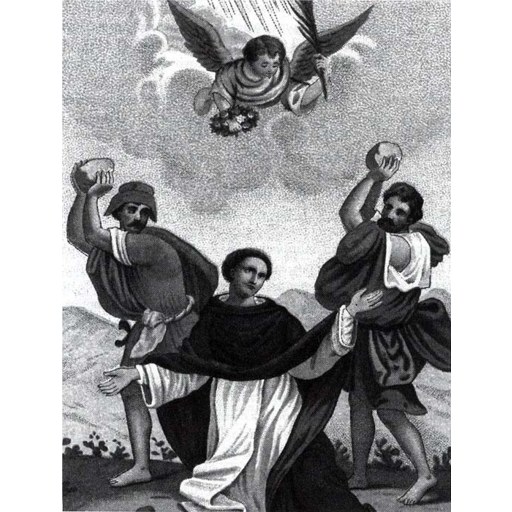
Unknown, Italian
License: Public domain
Anthony Neyrot
Blessed- Life Span
- 1425 - 1460 (age 35)
- Feast Day
- 10 April
- Gender
- male
- Church
- Catholic
Places
Roles & Family
Religious Information
Canonization
Biography
Anthony Neyrot (Italian: Antonio Neyrot) was a fifteenth-century Italian Dominican priest whose memory in the Catholic Church rests on his capture in North Africa, a period of apostasy to Islam, subsequent repentance, and death as a martyr at Tunis. He was born at Rivoli in Piedmont in 1425. He entered the Order of Preachers at the convent of San Marco in Florence, a principal center of the Dominican Observant movement. There he was associated with the circle of Saint Antoninus Pierozzi (Antoninus of Florence), the reforming prior who later became archbishop of that city. Neyrot was trained and ordained as a Dominican priest in this environment of strict observance and pastoral preaching.
In the course of his religious life he was sent to Sicily. While at sea he was seized by corsairs operating from the Maghreb and carried as a captive to Tunis, capital of the Hafsid realm. After a time in prison and under the hardships of slavery, he abandoned Christianity, accepted Islam, and married. Dominican hagiography treats this not as a feigned conversion but as a real, if temporary, apostasy. He lived for a period as a Muslim in Tunis; the precise length of that interval is not independently documented in surviving secular records and is known mainly from later religious accounts.
According to the traditional narrative, remorse and the report of Saint Antoninus's death in 1459 led Neyrot to return to the Christian faith. He then made a public recantation in Tunis, setting aside Islamic dress and professing Jesus Christ before the local authorities. Offered the chance to remain in Islam, he refused. He was imprisoned and, on 10 April 1460, executed by stoning. Catholic tradition regards this death as martyrdom, that is, as a witness unto death after reconciliation with the Church.
Relatively little can be verified about Neyrot from sources outside the Dominican and later Roman hagiographical tradition. His cult was fostered by the Order of Preachers. In 1767 Pope Clement XIII confirmed that cult, which in the practice of the time constituted beatification. He is commemorated as Blessed Anthony Neyrot, with a feast on 10 April. He is not recorded as having been formally canonized, nor as holding episcopal or papal office. Details such as the name of his wife, the exact circumstances of his capture, and his place of burial are not securely established in the historical record.