Antoine Daniel is a saint of the Catholic Church (1601 - 1648). Antoine Daniel's feast day is celebrated on 19 October (General Roman Calendar); 26 September (Canada). Antoine Daniel is the patron saint of Canada.
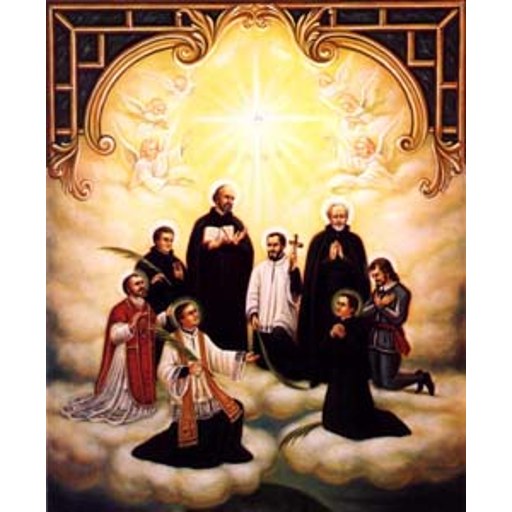
Unknown authorUnknown author
License: Public domain
Antoine Daniel
Saint- Life Span
- 1601 - 1648 (age 47)
- Feast Day
- 19 October (General Roman Calendar); 26 September (Canada)
- Gender
- male
- Church
- Catholic
Places
Roles & Family
Religious Information
Patronage
Canada
Canonization
Biography
Antoine Daniel was born on 27 May 1601 in Dieppe, a Channel port in Normandy, France. His father was a merchant, and the family belonged to the respectable commercial class of the city. After a classical education and a period in which a legal career was considered, he entered the novitiate of the Society of Jesus at Rouen on 1 October 1621. He taught grammar and humanities at the Jesuit college in Rouen for several years, then studied theology at the Collège de Clermont in Paris, and was ordained to the priesthood in 1631. When France recovered Canada from English occupation under the Treaty of Saint-Germain-en-Laye (1632), the Jesuits prepared to resume their missions in New France, and Daniel was assigned to that work.
He reached Quebec in 1633. In 1634 he travelled inland with Jean de Brébeuf and Ambroise Davost to Wendake, the country of the Wendat (Huron) confederacy around Georgian Bay in what is now Ontario. The canoe journey by the Ottawa River route was long and severe. In Huronia the Jesuits founded village missions, studied the Wendat language, and sought to preach Christianity within existing clan and council structures. In 1636 Daniel escorted a small group of Huron boys to Quebec in an attempt to establish a seminary where they might receive Christian instruction and a French education. The experiment, among the earliest residential schooling projects for Indigenous children in the St. Lawrence colony, was weakened by illness, deaths among the pupils, and the reluctance of families to leave their sons far from home. Daniel later returned to the mission field among the Wendat.
Through the 1640s he served at successive Huron stations, including Cahiagué and the large village of Teanaostaye, where the Jesuits kept the mission of Saint-Joseph. Those years were marked by epidemics that cut through Wendat communities, by tension between traditionalists and Christian converts, and by intensifying war with the Haudenosaunee (Iroquois) confederacy. Daniel worked as a pastor to Christian Hurons, baptized catechumens, and moved between villages under conditions of hunger, fatigue, and insecurity. Contemporary Jesuit Relations present him as even-tempered and pastorally zealous rather than as a public controversialist.
On the morning of 4 July 1648 Teanaostaye was surprised by a large Iroquois war party. Daniel had just celebrated Mass. He urged the inhabitants to flee, then appeared at the chapel door in his surplice in order to draw the attackers’ attention and to give absolution to those who could not escape. He was killed by musket fire and arrows near the church. The assailants threw his body into the burning chapel, where it was consumed; no burial place is therefore recorded. The fall of Teanaostaye belonged to the campaign that, within two years, broke the Huron confederacy and closed the Jesuit missions in Wendake. Several of Daniel’s Jesuit companions—Jean de Brébeuf, Gabriel Lalemant, Charles Garnier, and Noël Chabanel—were killed in 1649.
Devotion to Daniel and his companions developed in New France and later in Canada and the United States. The eight men known as the Canadian Martyrs or North American Martyrs—six Jesuit priests and two donnés (René Goupil and Jean de Lalande)—were beatified by Pope Pius XI on 21 June 1925 and canonized by the same pope on 29 June 1930. Their feast is kept on 19 October in the General Roman Calendar and on 26 September in Canada. As a group they were named secondary patrons of Canada. The Martyrs’ Shrine at Midland, Ontario, near the historic site of Sainte-Marie among the Hurons, is the principal centre of their veneration. Antoine Daniel is remembered as a missionary of seventeenth-century Huronia and as one of the canonized martyrs of New France.