Anton Granig is a servant of god of the Catholic Church (1901 - 1945).
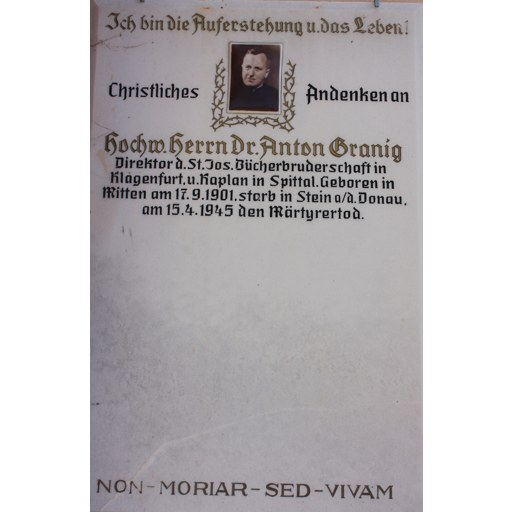
Neithan90
License: CC0
Anton Granig
Servant of God- Life Span
- 1901 - 1945 (age 44)
- Gender
- male
- Church
- Catholic
Places
Roles & Family
Biography
Anton Granig was an Austrian Roman Catholic priest of the Diocese of Gurk and a figure in the Catholic-inspired resistance to National Socialism in Carinthia. He was born in 1901 in Klagenfurt, in the Duchy of Carinthia, then a crown land of Austria-Hungary. After the collapse of the Habsburg monarchy he came of age in the First Austrian Republic. He pursued priestly formation for diocesan ministry rather than entering a religious order, and he was ordained to serve in ordinary parish work in Carinthia—a region with a strong Catholic culture and, in some districts, lasting ethnic and political tensions. Preaching, pastoral care, and the sacraments formed the core of his public life before the Anschluss.
The annexation of Austria by the German Reich in March 1938 subjected the Church to Gleichschaltung and to the anti-clerical pressures already familiar in Germany. Catholic associations, schools, youth work, and the press were curtailed or suppressed, and clergy who spoke too plainly risked harassment, imprisonment, or conscription. In that climate some priests confined themselves to purely sacramental ministry; others judged that Christian conscience required a more explicit rejection of the regime. Granig belonged to the latter group. In the early 1940s he took part in forming and leading the Antifaschistische Freiheitsbewegung Österreichs (Anti-fascist Freedom Movement of Austria), a relatively small Carinthian circle that joined opposition to National Socialism with the aim of restoring Austrian independence. The group produced and circulated leaflets and other writings that denounced the dictatorship and the war and appealed to Christian and Austrian patriotic sentiment.
The security services of the Reich treated such activity as high treason. After the Gestapo uncovered the network, Granig was arrested and held as a political prisoner. Like other members of the movement, he was brought before the Volksgerichtshof, the special political court created to try treason and related charges such as undermining military morale. He was condemned to death. In the spring of 1945, as Allied and Soviet armies closed in on the remaining territory of the Reich, the sentence was carried out in Vienna, only weeks before the German surrender in Europe.
Granig’s name is preserved in Austrian accounts of Catholic resistance and in local memory in Carinthia. He is often regarded as a priest who accepted death rather than abandon opposition to a regime he judged incompatible with Christian faith and with Austrian nationhood. The Catholic Church has not formally beatified or canonized him, and he has no universal feast day or officially assigned patronages. Memorials and historical literature in Austria nevertheless continue to record his priesthood, his role in the Carinthian resistance, and his execution in the last phase of the war.