Antoni Gaudí is a servant of god of the Catholic Church (1852 - 1926).
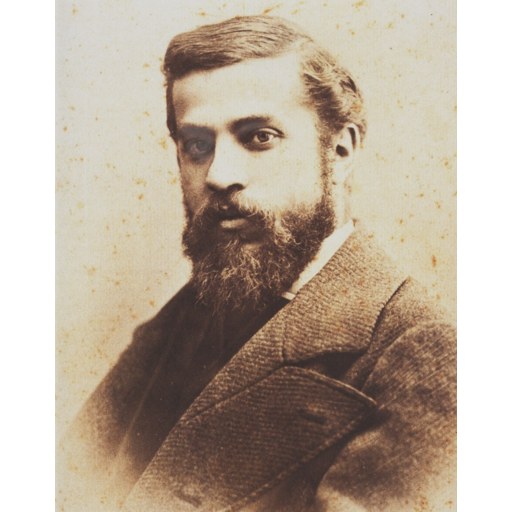
Pau Audouard Deglaire
License: Public domain
Antoni Gaudí
Servant of God- Life Span
- 1852 - 1926 (age 74)
- Gender
- male
- Church
- Catholic
Places
Relics & Where to Venerate
Location unknown
The bodily remains of Antoni Gaudí are a first-class relic. Venerated at Basilica and Expiatory Church of the Holy Family.
Roles & Family
Biography
Antoni Gaudí i Cornet was a Catalan architect and the central figure of Catalan Modernisme. He was born on 25 June 1852 and baptized the following day in the parish church of Sant Pere Apòstol in Reus, in the Province of Tarragona, then part of the Kingdom of Spain. A minority local tradition, which Gaudí himself sometimes repeated, places the birth at the family farmhouse of Mas de la Calderera in nearby Riudoms; the baptismal record and most standard reference works locate it in Reus. He was the son of the coppersmith Francesc Gaudí i Serra and Antònia Cornet i Bertran, and grew up among artisan metalworkers whose shop gave him an early, practical sense of volume and structure. Childhood rheumatism limited his physical activity and, according to later biographical accounts, encouraged close observation of plants, animals, and landscape. After schooling in Reus and Barcelona he entered the Escola Tècnica Superior d'Arquitectura in Barcelona and received his architect’s qualification in 1878.
In the late nineteenth and early twentieth centuries he developed a highly personal architectural language that joined Gothic and Mudéjar memories with catenary arches, hyperbolic paraboloids, and surfaces derived from natural growth. Early civic work included lampposts for Barcelona’s Plaça Reial. His principal private patron was the industrialist Eusebi Güell, for whom he designed Palau Güell, the park later known as Park Güell, and the church crypt at Colònia Güell. Other Barcelona houses that established his reputation include Casa Vicens, Casa Batlló, and Casa Milà (La Pedrera). Several of these buildings, together with the Nativity façade and crypt of the Sagrada Família, were later inscribed on the UNESCO World Heritage List. He also designed furniture, ironwork, and liturgical objects, and left a number of projects unfinished or only partly executed outside the city.
From 1883 he directed construction of the Expiatory Temple of the Sagrada Família, a church begun by Francisco de Paula del Villar. After about 1914–1915 he gave up almost all other commissions and lived in a workshop on the building site. He never married and had no children. Contemporaries described a life of growing austerity, a vegetarian diet, fasting, and daily attendance at Mass. He was a lay Catholic, not a member of a religious order, and he treated the Sagrada Família as a vast catechetical programme in stone. The social and anticlerical conflicts of early twentieth-century Catalonia, including the Tragic Week of 1909, formed the background of his last years, when he was often seen walking between the church and places of worship in the old city.
On 7 June 1926 he was struck by a tram on the Gran Via de les Corts Catalanes in Barcelona. His shabby clothing led those who first attended him to take him for a beggar, and he was taken to the Hospital de la Santa Creu. He died there on 10 June 1926 and was buried in the chapel of Our Lady of Mount Carmel in the crypt of the Sagrada Família, which was still far from complete. Work on the basilica has continued under later architects using his models and drawings, many of which were damaged in 1936. The Archdiocese of Barcelona opened a cause for his beatification in the 1990s, and the Holy See granted him the title Servant of God. He has not been beatified or canonized and has no official feast day or patronages in the liturgical calendar.