Antoninho da Rocha Marmo is a servant of god of the Catholic Church (1918 - 1930).
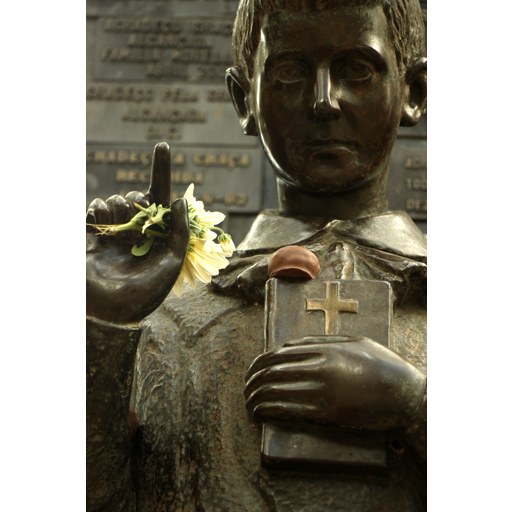
Urielpunk
License: CC BY-SA 3.0
Antoninho da Rocha Marmo
Servant of God- Life Span
- 1918 - 1930 (age 12)
- Gender
- male
- Church
- Catholic
Places
Relics & Where to Venerate
Location unknown
The bodily remains of Antoninho da Rocha Marmo are a first-class relic. Venerated at Consolação Cemetery.
Roles & Family
Biography
Antoninho da Rocha Marmo was a Brazilian Catholic child whose short life and patient endurance of a painful terminal illness gave him a lasting local reputation for holiness in São Paulo. He was born in 1918 in the city of São Paulo and died there in 1930 at the age of twelve. Widely available historical notices agree on these years and on his identity as a lay boy of a Catholic family, but they do not furnish a richly documented civil biography. What can be stated with caution is that he grew up in an urban Brazilian Catholic milieu in the early twentieth century, in which frequent Mass, the rosary, Eucharistic devotion, and popular Marian piety were ordinary features of family and parish life. Later hagiographical accounts describe him as obedient, charitable, and eager to share simple religious instruction with other children; such traits belong to the traditional portrait and should be read as the pious memory of his community rather than as independently verified psychological detail.
In the last period of his life Antoninho suffered from osteosarcoma, a malignant bone cancer, which caused severe pain and progressive disability. Traditional narratives of his illness emphasize that he accepted the disease as a share in the Passion of Christ and offered his sufferings for the conversion of sinners, for priests, and for the Church. He continued to receive the sacraments and to encourage those who visited him as his condition worsened. He died in São Paulo in 1930. Because he was a child, he was neither married nor a member of a religious institute, and he held no ecclesiastical office.
After his death, popular devotion formed around his memory in São Paulo. The faithful visited his burial place and attributed favors to his intercession. In time the Archdiocese of São Paulo opened a diocesan inquiry into his life and virtues, and he is commonly designated a Servant of God. He has not been beatified or canonized, and the Catholic Church has not assigned him an official liturgical feast or a list of patronages. Much of what circulates about his inner life comes from devotional literature rather than from critical archival biography; a careful historian therefore distinguishes the few secure facts of birth, illness, death, and subsequent local cult from the fuller portrait drawn by piety.
Antoninho’s story has been cited in Brazilian Catholic circles as an example of childhood holiness and of uniting personal suffering with Christ. Comparable twentieth-century figures of youthful piety exist in other countries, but his cult remains primarily regional. For an obscure Servant of God of this kind, the responsible account is necessarily limited: a São Paulo boy, born in 1918, dead of bone cancer in 1930, remembered for patience in illness, and still awaiting any Roman judgment on heroic virtue. Further precision about family names, exact addresses, the precise course of medical treatment, or the present location of his remains is not securely established in the sources that can be verified here, and is therefore omitted.