Antony II of Constantinople is a saint of the Catholic Church (d. 901). Antony II of Constantinople's feast day is celebrated on 12 February.
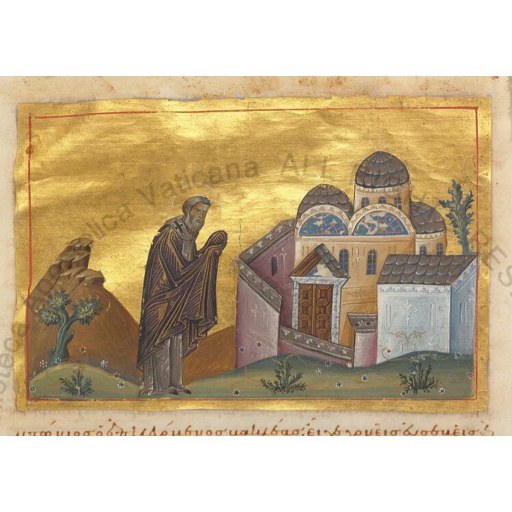
Authors of Menologion of Basil II (circa 985 AC, Constantinople), Byzantine manuscript illuminators[1]: Pantoleon with Georgios, Michael the Younger, Michael of Blachernae, Symeon, Symeon of Blachernae, Menas, and Nestor (Online on Vatican site)
License: Public domain
Antony II of Constantinople
Saint- Life Span
- d. 901
- Feast Day
- 12 February
- Gender
- male
- Church
- Catholic
Places
Roles & Family
Biography
Antony II Kauleas, also known as Anthony II of Constantinople, was Ecumenical Patriarch of Constantinople in the late ninth and early tenth centuries, holding office from 893 until his death in 901. He was born in Constantinople to a family of noble rank. From youth he entered the monastic life and in time became abbot of the monastery of Kauleas (or Kaulea) in the capital, a house from which his surname is taken. Byzantine sources present him as a man of marked asceticism and personal piety, formed in the monastic tradition of the imperial city during an age of bitter conflict within the Church of Constantinople.
That conflict, commonly called the Photian schism, had divided the Byzantine clergy and laity between the partisans of Patriarch Ignatius and those of Patriarch Photius through much of the ninth century. After Emperor Basil I restored Photius and then, following Basil's death, Emperor Leo VI the Wise deposed Photius in 886, the emperor placed his own younger brother Stephen I on the patriarchal throne. Stephen died in 893. Leo then selected Antony, the respected abbot of Kauleas, as his successor. Antony's appointment reflected both imperial preference and a desire for a hierarch who stood somewhat apart from the fiercest party strife.
As patriarch, Antony II is credited by later ecclesiastical historians with working to reconcile the Ignatian and Photian factions and to restore a measure of peace to the Church of Constantinople. His patriarchate of about eight years was comparatively quiet beside the turbulent tenures of Ignatius and Photius. He maintained the traditional close relationship between the patriarchate and the Macedonian dynasty at court, while Orthodox hagiographical tradition remembers him as a wonder-working hierarch and a man of prayer rather than as a political actor. The great tetragamy controversy over Emperor Leo VI's fourth marriage, which would shake the church in the following decade, arose only after Antony's death.
Antony II died on 12 February 901 in Constantinople. The Eastern Orthodox Church venerates him as a saint and commemorates him on 12 February. Historical evidence for his life is limited: he appears in patriarchal catalogues, brief chronicle notices, and later synaxaria, which stress his noble Constantinopolitan origin, his monastic career, his role as a peacemaker, and his holiness. Precise details of his birth, education, and many acts as patriarch are not preserved in surviving contemporary documents, and modern reconstructions necessarily remain cautious about anything beyond this outline.