Apollinaris is a saint of the Catholic Church. Apollinaris's feast day is celebrated on 20 July. Apollinaris is the patron saint of Ravenna;Emilia-Romagna;Düsseldorf;epilepsy;gout.
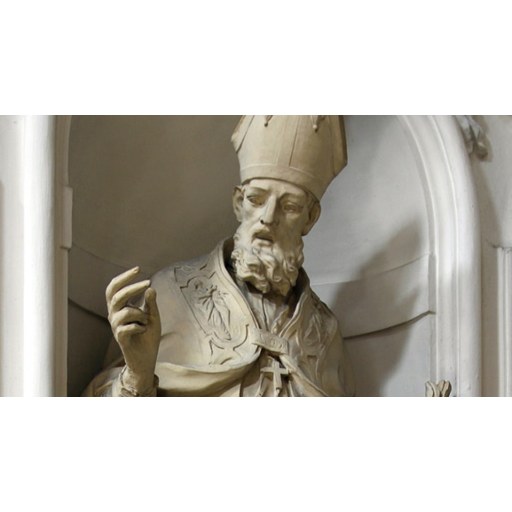
https://www.franciscanmedia.org/saint-of-the-day/saint-apollinaris/
License: unknown
Apollinaris
Saint- Feast Day
- 20 July
- Gender
- male
- Church
- Catholic
Places
Roles & Family
Patronage
Ravenna;Emilia-Romagna;Düsseldorf;epilepsy;gout
Biography
Saint Apollinaris, honoured as the first bishop of Ravenna, is among the principal early martyrs associated with the church of northern Italy, although almost everything reported about his life comes from later legend rather than from contemporary documents. The traditional Passio Sancti Apollinaris presents him as a native of Antioch in Syria and a disciple of the Apostle Peter, who is said to have ordained him and sent him to preach at Ravenna in the Roman province of Flaminia. There, according to the same account, he converted many of the inhabitants, healed the sick, and repeatedly suffered arrest, torture, and exile at the hands of pagan magistrates before dying as a martyr at Classis (Classe), the port of Ravenna. The Passio places these events in the apostolic age, often under the emperor Vespasian, but it is a work of much later composition, commonly assigned by modern scholars to about the seventh century, and cannot be treated as a reliable biography.
Independent historical evidence for the earliest bishops of Ravenna is sparse. The first occupant of the see who is firmly attested outside hagiographical literature is Severus, who took part in a synod in the mid-fourth century. That gap has led historians to treat the detailed narrative of Apollinaris’s missions, miracles, and successive passions as pious elaboration. The cult itself, however, is of genuine antiquity. By the sixth century Apollinaris was already venerated as the founding bishop and heavenly protector of the Ravennate church. The great basilica of Sant'Apollinare in Classe, consecrated in 549 under Archbishop Maximian during the reign of Justinian, was dedicated to him, and its apse mosaic shows him as a bishop standing in a paradisal landscape among his flock. Sant'Apollinare Nuovo, within the city of Ravenna, likewise bears his name. These monuments, erected when Ravenna was an imperial and then an Ostrogothic and Byzantine capital, prove that his memory was already central to the identity of the local church in late antiquity.
In the ninth century, when Classe was exposed to Saracen raids, the relics of Apollinaris were translated from the basilica at the port into the city, to Sant'Apollinare Nuovo. His feast was long kept on 23 July in the Roman liturgy; in the calendar reform of 1969 it was assigned to 20 July, while 23 July remains in use in some Eastern calendars and in older Western usage. He is invoked as patron of the city and archdiocese of Ravenna and of the region of Emilia-Romagna, and popular devotion has sought his intercession against epilepsy and gout. Relics and dedications carried the cult beyond Italy. In the Rhineland he became associated with Düsseldorf, of which he is a patron, and with pilgrimage churches such as that at Remagen on the Rhine and the church of Saint Apollinaris at Burtscheid near Aachen.
Whatever the historical kernel behind the legend, Apollinaris came to stand as the symbolic founder of one of the most important sees of late antique Italy. Ravenna’s later role as imperial residence and as a centre of Byzantine administration in the West gave his churches an artistic and political prominence far beyond a local martyr shrine. The mosaics of Sant'Apollinare in Classe and Sant'Apollinare Nuovo remain among the outstanding monuments of early Christian art, and they continue to shape how the saint is imagined: not as a figure whose career can be reconstructed year by year, but as the apostolic bishop-martyr in whom the church of Ravenna located its origins. Hagiographers therefore distinguish carefully between the richly developed Passio and the more limited but well-attested fact of an early, enduring, and artistically splendid cult centred on the first bishop of Ravenna.