Apollinaris is a saint of the Catholic Church. Apollinaris's feast day is celebrated on 20 July. Apollinaris is the patron saint of Ravenna;Emilia-Romagna;epilepsy;gout.
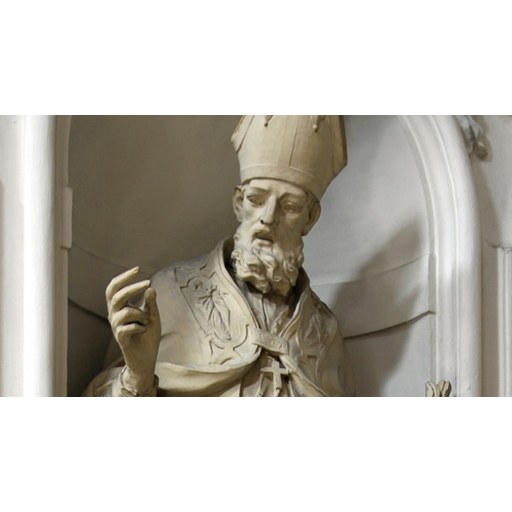
https://www.franciscanmedia.org/saint-of-the-day/saint-apollinaris/
License: unknown
Apollinaris
Saint- Feast Day
- 20 July
- Gender
- male
- Church
- Catholic
Places
Roles & Family
Patronage
Ravenna;Emilia-Romagna;epilepsy;gout
Biography
Saint Apollinaris of Ravenna is venerated as the first bishop of Ravenna and as a martyr of the early Church. The principal narrative of his life is the Latin Passio Sancti Apollinaris, a hagiographical text of uncertain date, generally assigned by scholars to late antiquity (often the fifth to seventh centuries) rather than to the apostolic age it describes. In that tradition he is a native of Antioch in Syria and a disciple of the Apostle Peter, who is said to have ordained him and sent him to preach at Ravenna, then an important city of Roman northern Italy with a port at Classe. No contemporary first- or second-century source confirms the Antiochene origin, the Petrine discipleship, or a precise chronology. What can be affirmed with greater confidence is that a bishop named Apollinaris became the focus of a major local cult which, by the sixth century, was promoted by the Ravennate church and is monumentalized in two famous basilicas.
According to the Passio, Apollinaris preached in Ravenna, converted members of the municipal and military elite, and performed healings that provoked the hostility of pagan priests and magistrates. The legend describes a long episcopate marked by repeated beatings, exile, and return: he is driven from the city, ministers for a time in other districts (some recensions send him as far as the Dalmatian coast), and is recalled, only to suffer again. After many years he is said to have been so badly wounded that he died of his injuries and was thus counted a martyr. The Passio and later martyrologies do not rest on dated official acts. Popular tradition sometimes placed his death under Vespasian in the later first century; other writers, noting that organized Christianity at Ravenna is more securely attested later, have preferred a second-century setting. Neither a year of birth nor a year of death can be verified from a reliable contemporary record, and no early source documents a wife, children, or membership in a religious order.
The historical cult is far better evidenced than the legendary biography. Sant'Apollinare in Classe, consecrated in 549 under Archbishop Maximian during the reign of Justinian, contains the celebrated apse mosaic of the saint as shepherd of his church; Sant'Apollinare Nuovo in the city, originally built by Theodoric, likewise bears his name. His body was long associated with Classe, the ancient port cemetery and basilica. In 856, because of the danger of Adriatic raids, the relics were translated inside the walls to the church of San Martino in Ciel d'Oro, thereafter known as Sant'Apollinare Nuovo. Ravenna's bishops treated him as founder of the local see. In the Roman Rite his feast is kept on 20 July (it stood on 23 July in the General Roman Calendar before the reform of 1969). He is the principal patron of Ravenna and is invoked for the region of Emilia-Romagna; later devotion also made him a patron against epilepsy and gout. Relics claimed as his head were in the Middle Ages also associated with the Apollinariskirche at Remagen on the Rhine.
A careful historical reading therefore separates a plausible early bishop of Ravenna, whose tomb became a metropolitan shrine, from the uncorroborated stories of apostolic commission and exactly dated martyrdom. He was not Bishop of Rome and did not hold a patriarchal or catholicosal see. Formal papal canonization in the later medieval sense was not applied to this immemorial cult, which the Church received through ancient veneration rather than a named canonizing pontiff. The figure who emerges from the sources is a missionary bishop and martyr of the Ravennate church, whose legend was shaped to give that church an apostolic pedigree, while the archaeology and liturgy of sixth-century Ravenna remain the firmest witnesses to his standing among the saints.