Apollonius of Tyana is a saint of the Catholic Church.
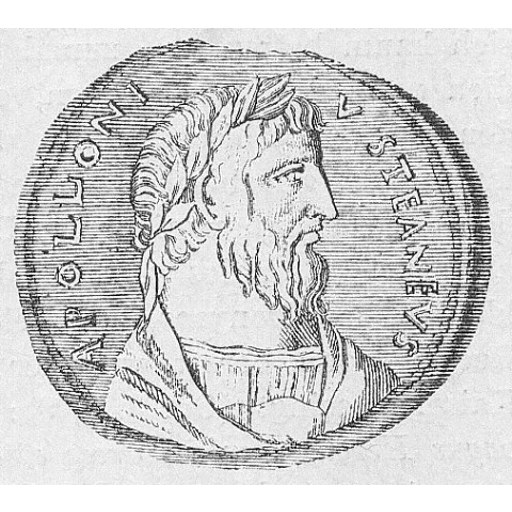
Unknown authorUnknown author
License: Public domain
Apollonius of Tyana
Saint- Gender
- male
- Church
- Catholic
Places
Roles & Family
Biography
Apollonius of Tyana was a Greek Neopythagorean philosopher and itinerant sage of the first century, born in the city of Tyana in Cappadocia in Anatolia, then within the orbit of the Roman Empire. Virtually nothing about his career can be established from contemporary documents. The principal narrative source is the Life of Apollonius of Tyana, an eight-book work composed by the Athenian sophist Flavius Philostratus in the early third century at the behest of the empress Julia Domna. Philostratus presented his book as based on the memoirs of a disciple named Damis, on civic records, and on letters, yet modern historians regard it as a literary creation that weaves together possible historical memories, Pythagorean doctrine, miracle tales, and the narrative techniques of the ancient novel.
In Philostratus’s account, Apollonius belonged to a prosperous family and studied in Tarsus and at the Asclepieion of Aegae in Cilicia. He adopted a strict Pythagorean regimen that included vegetarianism, abstinence from animal sacrifice and from clothing made of animal products, the wearing of long hair, and a five-year period of silence. He is consistently portrayed as unmarried and without children. After emerging from silence he traveled widely: through Asia Minor, Syria, and Mesopotamia, then, according to the biography, to India to converse with Brahmans, and later to Egypt, Ethiopia, and the Greek cities of Ionia and the mainland. He appears as a restorer of traditional cults, a counselor of cities, a healer, and an exorcist. Among the wonders attributed to him are the raising of a dead bride in Rome and various predictions, including foreknowledge of the assassination of Domitian.
Independent ancient testimony is meager. The second-century satirist Lucian mentioned a charlatan who claimed a connection with Apollonius. The historian Cassius Dio recorded that the emperor Caracalla dedicated a shrine to him. Letters circulating under Apollonius’s name were known in late antiquity; the majority are judged inauthentic, though a small number of brief letters may be earlier. In the third and fourth centuries pagan writers, notably Sossianus Hierocles, set Apollonius beside or above Jesus as a model of the divine man. Christian authors, above all Eusebius of Caesarea in his reply to Hierocles, attacked both the miracles and the credibility of Philostratus. Apollonius was never received as a saint in any Christian church, was neither canonized nor beatified, and possesses no feast day or recognized patronages.
The date, place, and manner of his death remain unknown. Philostratus offers more than one ending, including a mysterious vanishing from a temple of Dictynna on Crete and a tranquil old age. No historically secure burial site is recorded, although later Tyana maintained a cult place associated with his memory. If a historical teacher stands behind the legend, he was most probably a first-century Pythagorean ascetic and preacher active in the eastern provinces of the Roman Empire, whose reputation as a wonder-working holy man grew substantially in the generations after his death.