Apostle Barnabas is a saint of the Catholic Church (d. 61). Apostle Barnabas's feast day is celebrated on 11 June. Apostle Barnabas is the patron saint of Cyprus;Antioch;Milan;against hailstorms;peacemakers.
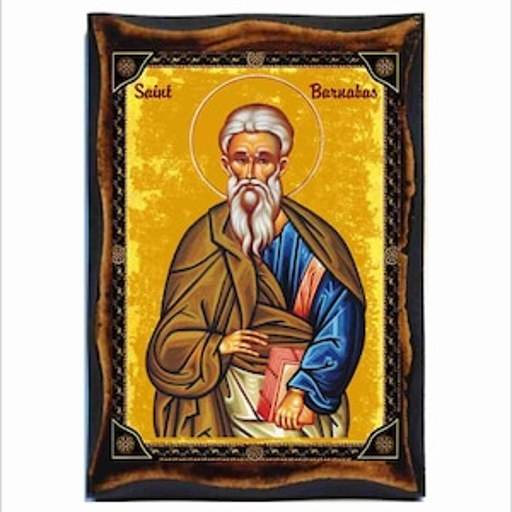
https://www.etsy.com/market/barnabas_icon
License: unknown
Apostle Barnabas
Saint- Life Span
- d. 61
- Feast Day
- 11 June
- Gender
- male
- Church
- Catholic
Places
Roles & Family
Patronage
Cyprus;Antioch;Milan;against hailstorms;peacemakers
Biography
Barnabas, whose original name was Joseph (also rendered Joses), was a Jewish Levite and a native of Cyprus. He is known from the New Testament as one of the most influential leaders of the earliest Christian movement, though he was not one of the Twelve Apostles. The Acts of the Apostles records that the apostles in Jerusalem gave him the name Barnabas, explained as meaning 'son of encouragement' or 'son of consolation.' He first appears in the narrative of the Jerusalem church as a man of property who sold a field and laid the money at the apostles' feet for the common fund of the community. This episode, set in the earliest years of the church in Judaea in the first century, established his reputation for generosity and for strengthening others.
Barnabas became a decisive mediator in the acceptance of Saul of Tarsus, later known as Paul, by the wary disciples in Jerusalem. After Saul's conversion, when many still feared him because of his former persecution of Christians, Barnabas brought him to the apostles and recounted Saul's experience on the road to Damascus and his subsequent preaching. Later, when the church in Jerusalem heard that a substantial number of Gentiles in Antioch were turning to the faith, they sent Barnabas to investigate. Encouraged by what he found, he went to Tarsus to seek out Paul and brought him back to Antioch. The two men taught there for a considerable period, and it was in Antioch that the disciples were first called Christians. The church of Antioch, after prayer and fasting, then commissioned Barnabas and Paul for missionary work. They traveled first to Cyprus, Barnabas's homeland, and then through cities of Asia Minor, preaching in synagogues and among Gentiles. In that missionary context the New Testament refers to both men as apostles. They also took part in the council held in Jerusalem concerning whether Gentile converts must be circumcised and keep the Mosaic law, supporting the decision that Gentiles need not take on the full yoke of the Law.
A later disagreement between Barnabas and Paul, recorded in Acts, concerned John Mark, whom the Letter to the Colossians identifies as Barnabas's cousin. Mark had withdrawn from an earlier journey, and Paul refused to take him again; Barnabas insisted. The two leaders separated: Barnabas took Mark and sailed to Cyprus, while Paul chose Silas. This is the last appearance of Barnabas in the Acts of the Apostles. Paul nevertheless continued to speak of Barnabas with respect in his letters, including First Corinthians, which indicates that Barnabas was still known as an active apostle who, like Paul, worked to support himself. Extra-biblical Christian tradition, especially associated with Cyprus and attested in later writings such as the fifth-century Acts of Barnabas, holds that Barnabas continued to evangelize on the island and was put to death at Salamis, traditionally by stoning. His burial was associated with a site near Salamis. In the late fifth century, according to Cypriot ecclesiastical tradition, his tomb was identified and a manuscript of the Gospel of Matthew was said to have been found with the remains, an event used to support the autocephaly of the Church of Cyprus.
Barnabas has been venerated from antiquity as an apostle and as the founder of the Church of Cyprus. Some Western traditions, particularly connected with Milan, have also associated him with the early evangelization of that city, though this rests on later legend rather than first-century evidence. An early Christian text known as the Epistle of Barnabas was attributed to him by some ancient writers, but modern scholarship generally dates that work to the early second century and does not regard it as his composition. He is commemorated on 11 June in the calendars of the Roman Catholic Church, the Eastern Orthodox Church, and other Christian traditions. He is invoked as a patron of Cyprus and of Antioch, and in popular devotion against hailstorms, and is remembered as a peacemaker and as a model of encouragement in the life of the church.