Apostle James is a saint of the Catholic Church (d. 44). Apostle James's feast day is celebrated on 25 July (Western churches); 30 April (Eastern Orthodox). Apostle James is the patron saint of Spain;Galicia;Santiago de Compostela;pilgrims;the Camino de Santiago;knights;the Order of Santiago;laborers;veterinarians;pharmacists;equestrians;tanners;hatmakers;rheumatism;arthritis;Guatemala;Nicaragua.
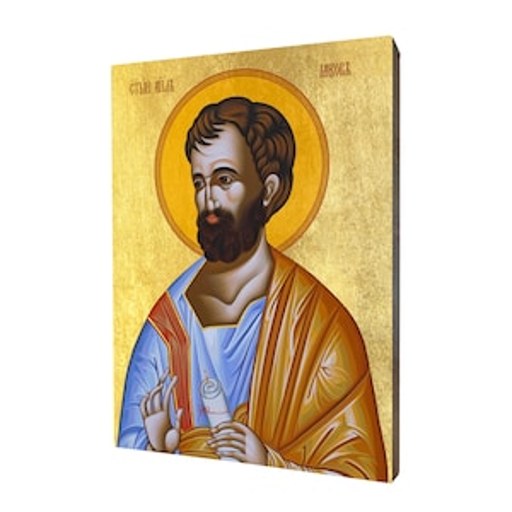
https://etsy.com/market/apostle_james
License: unknown
Apostle James
Saint Apostle- Life Span
- d. 44
- Feast Day
- 25 July (Western churches); 30 April (Eastern Orthodox)
- Gender
- male
- Church
- Catholic
Places
Roles & Family
Patronage
Spain;Galicia;Santiago de Compostela;pilgrims;the Camino de Santiago;knights;the Order of Santiago;laborers;veterinarians;pharmacists;equestrians;tanners;hatmakers;rheumatism;arthritis;Guatemala;Nicaragua
Biography
James, known in later tradition as James the Greater to distinguish him from James son of Alphaeus (James the Less) and from James the brother of the Lord, was one of the Twelve Apostles chosen by Jesus. The canonical Gospels present him as a Galilean Jew, the son of the fisherman Zebedee and the elder brother of John, who is traditionally identified with the beloved disciple and with the author of the Fourth Gospel. Mark notes that Zebedee had hired servants in the boats, which implies that the family was not among the poorest of lakeside laborers. A woman named Salome, listed among those who observed the crucifixion and who brought spices to the tomb, is widely identified in Christian tradition as the mother of James and John, though the Gospels do not state that relationship in so many words. Jesus called James and John from their father's boat on the Sea of Galilee as they were mending nets; they left Zebedee and followed him. Mark records that Jesus surnamed the pair Boanerges, 'sons of thunder.' The nickname is usually connected with their zeal: they asked whether they should command fire to come down on a Samaritan village that would not receive Jesus, and they sought the places of honor at his right and left hand in the coming kingdom, a request Jesus refused while predicting that they would drink his cup.
James belonged to the innermost group of three disciples. With Peter and John he was admitted to the raising of Jairus's daughter when others were excluded, to the Transfiguration, where the three saw Jesus speaking with Moses and Elijah, and to the garden of Gethsemane, where the same three were asked to watch while Jesus prayed before his arrest. After Pentecost he appears in the list of apostles in Jerusalem. The New Testament preserves no letter under his name and no itinerary of a mission outside Palestine. The only subsequent episode is his death. The Acts of the Apostles states that about that time Herod the king stretched out his hand to afflict some of the church, and that he killed James the brother of John with the sword. The Herod in question is Agrippa I, who ruled Judea from 41 until his death in 44. Acts places the execution in a Passover setting and immediately afterward narrates Agrippa's own end at Caesarea, an event independently dated by Josephus to 44. Scholarly consensus therefore assigns James's martyrdom to the year 44. He is the first of the Twelve known to have been killed, and the only apostle whose death is explicitly recorded in the New Testament. Execution by the sword indicates beheading, a penalty Agrippa could impose as client king.
Later ages filled the silence of the sources with legend. A tradition that James had evangelized Spain appears in the Latin West by the seventh century and became firmly established in Iberian piety. Related medieval narratives held that, after his death in Jerusalem, disciples placed his body in a stone boat that was guided miraculously to the Galician coast, and that the tomb, long forgotten, was revealed in the early ninth century, giving rise to the church and then the cathedral of Santiago de Compostela. From the tenth and eleventh centuries Compostela ranked with Rome and Jerusalem as a goal of major pilgrimage; the scallop shell, staff, and gourd became James's attributes as pilgrim. In the later Middle Ages Spanish royal and military devotion recast him as Santiago Matamoros, a mounted warrior intervening in battles against Muslim armies. Careful historical scholarship does not treat the Spanish mission or the translation of the body as first-century events. No early Eastern or Palestinian source describes a journey to Iberia, and the Compostela cult is a medieval phenomenon. The original place of burial after the beheading in Jerusalem is unknown.
Veneration of James is ancient in both East and West. The principal feast in the Roman Rite and in most Western calendars falls on 25 July; Byzantine churches commemorate him on 30 April. He is patron of Spain and of the region of Galicia, of the city and pilgrimage of Santiago de Compostela, of pilgrims in general, and of numerous places in the Americas named Santiago. He is also invoked as patron of knights (including the medieval Order of Santiago), laborers, veterinarians, pharmacists, equestrians, tanners, hatmakers, and those afflicted with rheumatism and arthritis. He held no patriarchal see and was never Bishop of Rome. He belonged to no monastic or mendicant order, institutions that arose many centuries later. Ancient sources do not record whether he married or had children. Because he died in the apostolic age, long before the medieval procedures of beatification and canonization, no pope formally declared him a saint; his status rests on the New Testament and on uninterrupted cult.