Apostle James is a saint of the Catholic Church (d. 44). Apostle James's feast day is celebrated on 25 July. Apostle James is the patron saint of Spain;Galicia;Santiago de Compostela;pilgrims;the Camino de Santiago;Guatemala;Nicaragua;knights;laborers;veterinarians;pharmacists;hatmakers;tanners;equestrians;rheumatism;arthritis.
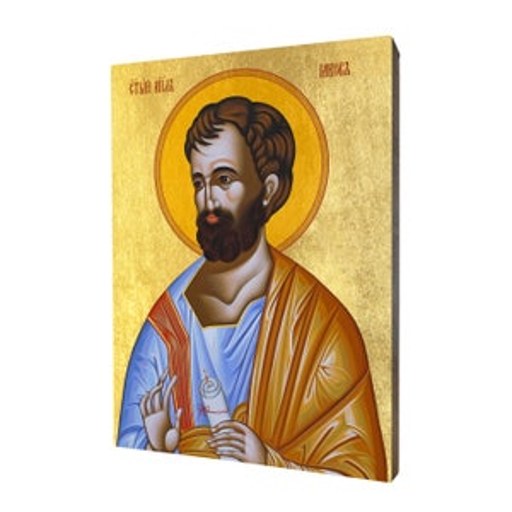
https://etsy.com/market/apostle_james
License: unknown
Apostle James
Saint Apostle- Life Span
- d. 44
- Feast Day
- 25 July
- Gender
- male
- Church
- Catholic
Places
Roles & Family
Patronage
Spain;Galicia;Santiago de Compostela;pilgrims;the Camino de Santiago;Guatemala;Nicaragua;knights;laborers;veterinarians;pharmacists;hatmakers;tanners;equestrians;rheumatism;arthritis
Biography
James, son of Zebedee, known in later Christian tradition as James the Greater to distinguish him from James son of Alphaeus, was one of the Twelve Apostles of Jesus of Nazareth and the brother of the apostle John. The Synoptic Gospels describe him as a Galilean fisherman who worked on the Sea of Galilee with his brother and their father Zebedee, at times in partnership with Simon Peter. Jesus called James and John from their boat; they left their father and the hired servants and followed him. Mark records that Jesus gave the brothers the Aramaic nickname Boanerges, interpreted as sons of thunder, a designation usually taken to reflect a fervent or impetuous temperament. With Peter, James and John formed a smaller circle within the Twelve. The Gospels place the three at the raising of the daughter of Jairus, at the Transfiguration, and at the agony of Jesus in Gethsemane. James and John, or their mother on their behalf, are also remembered for requesting seats of honor in the coming kingdom, an episode Jesus answered with a saying about drinking his cup, later read as a foreshadowing of James's martyrdom.
The New Testament does not record the year or place of James's birth. He belonged to a fishing household of Galilee in the early first century, in the tetrarchy of Herod Antipas. Later tradition has sometimes named Bethsaida or Capernaum as his home, but the canonical texts do not state a birthplace, and those identifications remain inferences from the Galilean fishing milieu. His father Zebedee is named; his mother is commonly identified with Salome, one of the women who witnessed the crucifixion and visited the tomb, though that identification depends on comparing the lists of women in the Gospels and is not certain. Speculative reconstructions that make Salome a sister of Mary the mother of Jesus, and thus make James a cousin of Jesus, remain unproven. Nothing reliable is known of a wife or children.
After the resurrection, James appears among the apostles in the opening of Acts, but the narrative then falls silent about him until his death. Acts states that Herod Agrippa I, during a persecution directed at the Jerusalem church, killed James the brother of John with the sword. Agrippa I ruled Judea from 41 until his death in 44, and Acts situates the execution of James not long before the king's own end, which Josephus dates to 44. On that basis historians conventionally place the martyrdom in Jerusalem about the year 44. James is thereby remembered as the first of the Twelve to die as a martyr. Eusebius of Caesarea, drawing on Clement of Alexandria, recounts that the apostle's accuser was converted by James's testimony and was beheaded together with him; the anecdote is early but cannot be confirmed from independent evidence. No contemporary source describes the burial.
From late antiquity and especially from the early Middle Ages, Western legend asserted that James had evangelized Hispania and that his relics were translated to Galicia, where the shrine of Santiago de Compostela became a principal pilgrimage destination of medieval Christendom. These claims are absent from the New Testament and from the earliest patristic notices of the apostle, and modern historical scholarship treats the Spanish mission and the Compostela translation as later pious tradition rather than established fact. James was venerated as an apostle from the first Christian centuries without a formal process of canonization. In the Latin Church his chief feast is 25 July; Byzantine calendars commonly keep 30 April. He is invoked as patron of Spain, of Galicia and Santiago de Compostela, of pilgrims and the Camino de Santiago, of several countries and professions, and of those suffering from rheumatism and arthritis.