Apostle Paul is a saint of the Catholic Church. Apostle Paul's feast day is celebrated on 29 June (Saints Peter and Paul); 25 January (Conversion of Saint Paul). Apostle Paul is the patron saint of missionaries;theologians;evangelists;tentmakers;Malta;Rome;Gentile Christians;Catholic Action;Cursillo movement;rope makers;weavers;saddlers;against snakebite;writers;Pontifical Mission Societies.
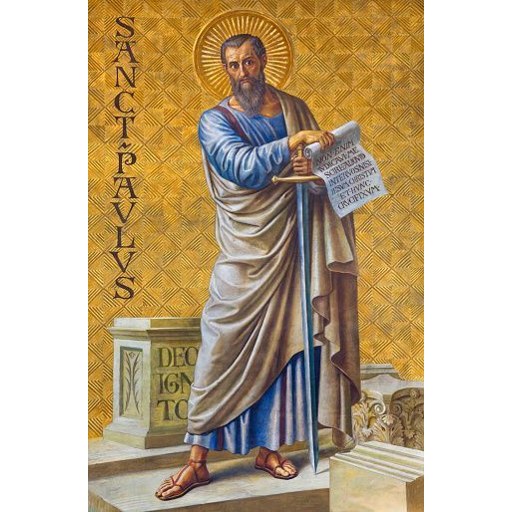
https://www.pinterest.com/ideas/paul-the-apostle-art/949959410756/
License: unknown
Apostle Paul
Saint Apostle- Feast Day
- 29 June (Saints Peter and Paul); 25 January (Conversion of Saint Paul)
- Gender
- male
- Church
- Catholic
Places
Roles & Family
Patronage
missionaries;theologians;evangelists;tentmakers;Malta;Rome;Gentile Christians;Catholic Action;Cursillo movement;rope makers;weavers;saddlers;against snakebite;writers;Pontifical Mission Societies
Biography
Paul, known in his Jewish life as Saul, was a first-century figure from Tarsus in Cilicia, a prominent city of the eastern Roman Empire. The Acts of the Apostles and his own surviving letters present him as a Jew of the tribe of Benjamin, a Pharisee, and a Roman citizen by birth. He received a rigorous education in the Jewish Law and, according to Acts, studied in Jerusalem under the respected teacher Gamaliel. In his early years he was a determined opponent of the Jesus movement, participating in efforts to suppress it, including the events surrounding the death of Stephen. The same sources describe a decisive conversion while he was traveling to Damascus, an experience he later interpreted as a revelation of the risen Christ and a commission to preach among the Gentiles. After a period in Arabia and a return to Damascus, he eventually made his way to Jerusalem and then to Antioch in Syria, which became a base for his missionary work.
From Antioch, Paul undertook extensive travels through Cyprus, Asia Minor, Macedonia, and Achaia during the middle decades of the first century. He founded or nurtured Christian assemblies in cities such as Philippi, Thessalonica, Corinth, and Ephesus, working often as a tentmaker to support himself. His strategy typically involved speaking first in synagogues and then turning to Gentile audiences when opposition arose. Conflicts over whether Gentile converts must observe the Jewish Law, including circumcision, led to a council in Jerusalem, after which Paul continued to argue vigorously that Gentiles were incorporated into the people of God by faith apart from works of the Law. The letters generally accepted by critical scholarship as authentically his—Romans, 1 and 2 Corinthians, Galatians, Philippians, 1 Thessalonians, and Philemon—address concrete problems in these communities and develop a theology of the cross, justification, the Spirit, and the church as the body of Christ. Other New Testament letters bearing his name are of disputed authorship.
Paul’s later career, as narrated in Acts, included a return to Jerusalem, arrest in the Temple precincts, imprisonment at Caesarea under Roman governors, and an appeal to the emperor that brought him to Rome. Acts concludes with Paul living under house arrest in the capital, receiving visitors and teaching. Independent early Christian testimony, beginning with the First Letter of Clement near the end of the first century, indicates that Paul suffered martyrdom. Later tradition, recorded by Eusebius and others, places his death in Rome during the Neronian period, by beheading, a penalty consistent with Roman citizenship. From late antiquity a tomb on the Via Ostiense has been venerated as his; the Basilica of Saint Paul Outside the Walls stands over that site, and a sarcophagus discovered beneath the main altar in the early twenty-first century has been associated by church authorities with the apostle.
Paul’s writings became a central pillar of the New Testament canon and have shaped Christian doctrine in East and West for nearly two millennia. Augustine, Luther, and countless later interpreters made his letters the starting point for debates on grace, faith, and the church. He is commemorated with the Apostle Peter on 29 June, a feast of great antiquity in Rome, and his conversion is observed on 25 January. Christian tradition regards him as patron of missionaries and theologians, of tentmakers and related crafts, of the island of Malta (where Acts recounts a shipwreck), and of the city of Rome together with Peter. Because the principal sources are theological as well as historical, many details of chronology, the sequence of journeys, and the circumstances of his death cannot be fixed with precision; historians therefore speak in terms of the mid-first century and the broader context of the early Roman Empire rather than of exact years.