Apostle Paul is a saint of the Catholic Church. Apostle Paul's feast day is celebrated on 29 June (Saints Peter and Paul); 25 January (Conversion of Saint Paul). Apostle Paul is the patron saint of missionaries;theologians;tentmakers;evangelists;Gentile Christians;Malta;Rome;writers;journalists;rope makers;weavers;Cursillo movement;against snakebite.
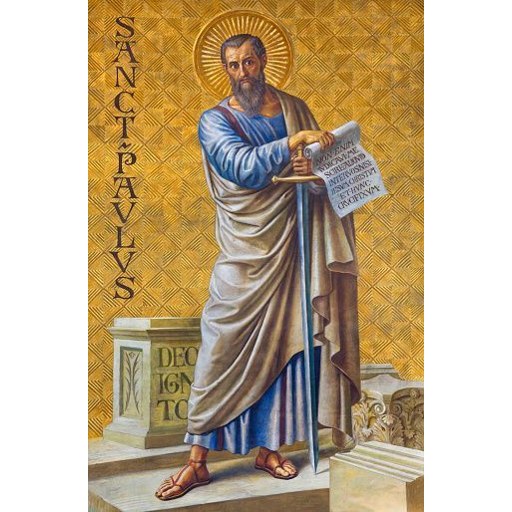
https://www.pinterest.com/ideas/paul-the-apostle-art/949959410756/
License: unknown
Apostle Paul
Saint Apostle- Feast Day
- 29 June (Saints Peter and Paul); 25 January (Conversion of Saint Paul)
- Gender
- male
- Church
- Catholic
Places
Roles & Family
Patronage
missionaries;theologians;tentmakers;evangelists;Gentile Christians;Malta;Rome;writers;journalists;rope makers;weavers;Cursillo movement;against snakebite
Canonization
Biography
Saul of Tarsus, known after his conversion as the Apostle Paul, was a first-century Jew from Tarsus in Cilicia, a major Hellenistic city of the eastern Roman Empire. According to the Acts of the Apostles he was a Roman citizen by birth and a Pharisee, and he is said to have been trained in Jerusalem under the teacher Gamaliel. In his own letters he identifies himself as a Hebrew of Hebrews, of the tribe of Benjamin, and as one who had advanced in Judaism beyond many contemporaries through zeal for the ancestral traditions. Before his conversion he was an active opponent of the early Jesus movement: he writes that he persecuted the church of God violently and tried to destroy it. Acts portrays him as present at the stoning of Stephen and as obtaining authority to arrest disciples in Damascus.
The turning point of his life was an encounter with the risen Christ, which Paul treats as the source of his apostleship and which Acts narrates as a vision on the road to Damascus. After a period that included time in Arabia and a return to Damascus, he went up to Jerusalem and later worked from Antioch. From there he undertook extensive missionary travel through Cyprus, Asia Minor, Macedonia, and Achaia, founding and corresponding with communities of Gentile and Jewish believers. His undisputed letters—among them Romans, 1 and 2 Corinthians, Galatians, Philippians, 1 Thessalonians, and Philemon—are the earliest surviving Christian writings and the principal source for his thought. In them he proclaims justification by faith in Christ apart from works of the Law, the inclusion of the Gentiles, the death and resurrection of Jesus as the center of the gospel, and a coming eschatological consummation. He supported himself at least in part by tentmaking, organized a collection for the poor in Jerusalem, and repeatedly faced imprisonment, beatings, and opposition from both Jewish and civic authorities.
Acts describes a final journey to Jerusalem, arrest in the Temple precincts, hearings before Jewish and Roman authorities, and an appeal to the emperor that brought him to Rome, where he spent two years under house arrest preaching. The New Testament does not record his death. Early Christian tradition, already reflected in the First Letter of Clement near the end of the first century, holds that Paul suffered martyrdom. Later writers, including Eusebius and Jerome, place his execution in Rome during the reign of Nero, commonly by beheading—the form of death associated with Roman citizens—and locate his burial along the Ostian Way. The Basilica of Saint Paul Outside the Walls stands over the traditional tomb; a sarcophagus beneath the high altar has been associated with the apostle since late antiquity.
Paul was never Bishop of Rome and held no patriarchal see; his authority in the churches was that of an apostle to the Gentiles. In 1 Corinthians he describes himself as unmarried and commends that state for those who can accept it; no spouse or children are named in the surviving sources. Veneration of Paul is ancient and universal in East and West. His principal feast, shared with the Apostle Peter, is 29 June; the Western church also keeps 25 January as the Conversion of Saint Paul. He is invoked as patron of missionaries, theologians, tentmakers, and Malta, among other causes, and his letters have remained foundational for Christian doctrine, ethics, and the interpretation of Scripture.