Apostle Paul is a saint of the Catholic Church. Apostle Paul's feast day is celebrated on 29 June. Apostle Paul is the patron saint of missionaries;theologians;evangelists;Gentile Christians;tentmakers;Rome;Malta;Greece;authors;publishers;rope makers;saddle makers;Catholic Action;Cursillo movement;against snakebite.
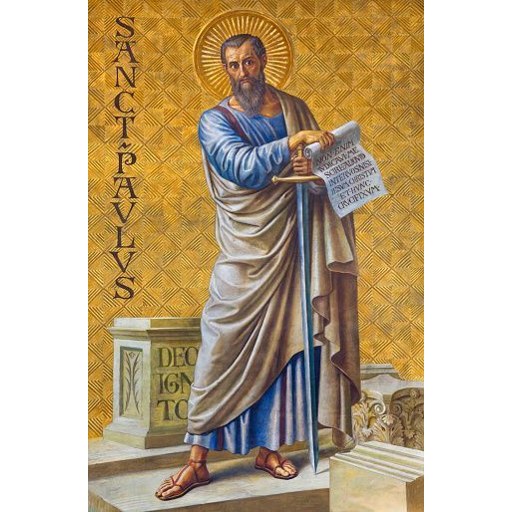
https://www.pinterest.com/ideas/paul-the-apostle-art/949959410756/
License: unknown
Apostle Paul
Saint Apostle- Feast Day
- 29 June
- Gender
- male
- Church
- Catholic
Places
Roles & Family
Patronage
missionaries;theologians;evangelists;Gentile Christians;tentmakers;Rome;Malta;Greece;authors;publishers;rope makers;saddle makers;Catholic Action;Cursillo movement;against snakebite
Biography
Paul the Apostle, known in life as Saul of Tarsus and in Christian tradition as Saint Paul, was a first-century Jewish preacher, letter-writer, and missionary whose work was decisive in spreading the Jesus movement among Gentiles across the eastern Roman Empire. He was born in Tarsus in Cilicia, in what is now southern Turkey, to a Jewish family of the tribe of Benjamin, and he possessed Roman citizenship by birth. The Acts of the Apostles presents him as educated in Jerusalem in the Pharisaic tradition under Gamaliel. Before his conversion he was a zealous opponent of the followers of Jesus: Acts depicts him as consenting to the stoning of Stephen and as obtaining authority to arrest believers in Damascus. His own letters confirm that he had persecuted the church.
The New Testament describes his conversion as a visionary encounter with the risen Christ on the road to Damascus, after which he was baptized and began to proclaim Jesus as Messiah. He spent a period in Arabia and Damascus, later visited Jerusalem, and in time made Antioch in Syria a principal base. From there he undertook extended journeys through Cyprus, Asia Minor, Macedonia, and Achaia, founding and corresponding with communities in cities such as Philippi, Thessalonica, Corinth, and Ephesus. A large part of the New Testament consists of letters attributed to him. Modern scholarship generally treats Romans, 1 and 2 Corinthians, Galatians, Philippians, 1 Thessalonians, and Philemon as authentic; the authorship of 2 Thessalonians, Colossians, Ephesians, and the Pastoral Epistles remains debated. In these writings he argued that Gentiles could belong to the people of God through faith in Christ without full observance of the Mosaic law, and he developed themes of justification, the church as the body of Christ, and an imminent eschatological hope.
Paul’s preaching repeatedly brought him into conflict with both Jewish and civic authorities. Acts recounts his arrest in Jerusalem, a long imprisonment at Caesarea, and his appeal as a Roman citizen to the emperor, after which he was sent to Rome. The canonical narrative ends with him under house arrest in the capital, preaching freely. Later Christian tradition, already reflected in late first- and second-century sources, holds that he was executed in Rome during the persecution under Nero, typically by beheading in view of his citizenship. A tomb associated with him has been venerated on the Ostian Way since late antiquity and is now enclosed in the Basilica of Saint Paul Outside the Walls. Precise years of birth and death are not securely attested; ancient and modern estimates place his activity in the mid-first century and his death in the 60s.
Paul’s letters and the portrait in Acts made him, after Jesus, the most influential figure in the formation of Christian doctrine and practice. He is commemorated with the Apostle Peter on 29 June and in the feast of his conversion on 25 January. In Christian tradition he is invoked as a patron of missionaries, theologians, tentmakers, and places linked to his life and cult, including Rome and Malta. He was never Bishop of Rome or a patriarch of an Eastern see, and like other apostolic-age saints he was venerated by popular acclaim rather than by a later formal process of beatification or canonization.