Apostle Paul is a saint of the Catholic Church. Apostle Paul's feast day is celebrated on 29 June. Apostle Paul is the patron saint of missionaries;theologians;evangelists;tentmakers;Malta;Rome;Gentile Christians;rope-makers;saddle-makers;against hailstorms;against snakes;Catholic Action;Cursillo movement;lay apostolate;pastoral ministers;Pontifical Mission Societies;publishers;public relations personnel.
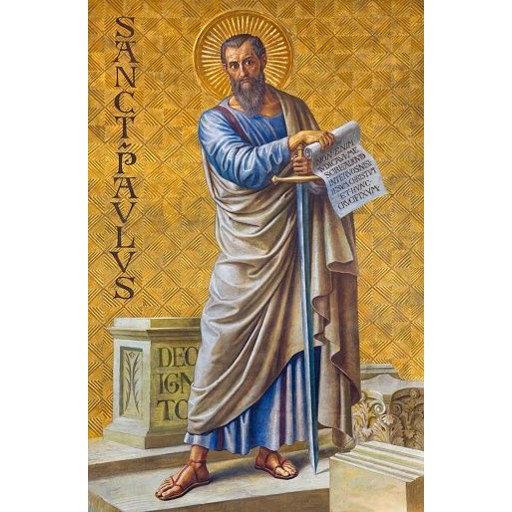
https://www.pinterest.com/ideas/paul-the-apostle-art/949959410756/
License: unknown
Apostle Paul
Saint Apostle- Feast Day
- 29 June
- Gender
- male
- Church
- Catholic
Places
Roles & Family
Patronage
missionaries;theologians;evangelists;tentmakers;Malta;Rome;Gentile Christians;rope-makers;saddle-makers;against hailstorms;against snakes;Catholic Action;Cursillo movement;lay apostolate;pastoral ministers;Pontifical Mission Societies;publishers;public relations personnel
Biography
Saul of Tarsus, later known as the Apostle Paul, was a first-century Jewish figure from Tarsus in Cilicia who became one of the most influential missionaries and theologians of early Christianity. Born into a Jewish family of the tribe of Benjamin and raised as a Pharisee, he was also a Roman citizen, a status that later affected his legal proceedings. According to the Acts of the Apostles, he studied in Jerusalem under the respected teacher Gamaliel. In his early adulthood he was a zealous opponent of the Jesus movement and took part in the persecution of its adherents, including the events surrounding the death of Stephen.
Paul’s life changed after an experience that he and later Christian tradition described as an encounter with the risen Jesus on the road to Damascus. After a period of withdrawal, including time in Arabia and a return to Damascus, he eventually joined the Christian community in Antioch. From there he undertook missionary journeys across Cyprus, Asia Minor, Macedonia, and Greece, founding and nurturing communities among both Jews and Gentiles. He insisted that Gentile converts need not take on the full ritual requirements of the Mosaic law, a stance that caused controversy and was addressed at the gathering in Jerusalem described in Acts and in his letter to the Galatians.
A large part of the New Testament consists of letters attributed to Paul, written to churches and individuals to treat theological questions, ethical conduct, and disputes within communities. The seven letters most widely accepted by scholars as authentically Pauline—Romans, 1 and 2 Corinthians, Galatians, Philippians, 1 Thessalonians, and Philemon—set out his understanding of justification, the role of the law, the meaning of Christ’s death and resurrection, and the unity of Jew and Gentile in the church. Other letters in the Pauline corpus are regarded by many scholars as later compositions in his name or tradition.
Paul was arrested in Jerusalem, held in custody in Caesarea, and, exercising his right as a Roman citizen, appealed to the emperor. He was taken to Rome, where the narrative of Acts leaves him under house arrest. Early Christian tradition, already reflected in the late first-century letter known as 1 Clement and later by writers such as Eusebius, holds that he was martyred in Rome during the reign of Nero, commonly by beheading. A tomb long associated with him has been venerated at the Basilica of Saint Paul Outside the Walls. His writings and missionary work were decisive in shaping the theology, geography, and self-understanding of the early church, and he has been commemorated as an apostle and martyr throughout Christian history.