Apostle Paul is a saint of the Catholic Church. Apostle Paul's feast day is celebrated on 29 June (with Saint Peter); 25 January (Conversion of Saint Paul). Apostle Paul is the patron saint of missionaries;theologians;evangelists;tentmakers;Malta;Rome;Gentile Christians;Cursillo movement;rope makers;saddlers;weavers;against snakebite;Catholic Action;lay apostolate;São Paulo;London;Pontifical Mission Societies.
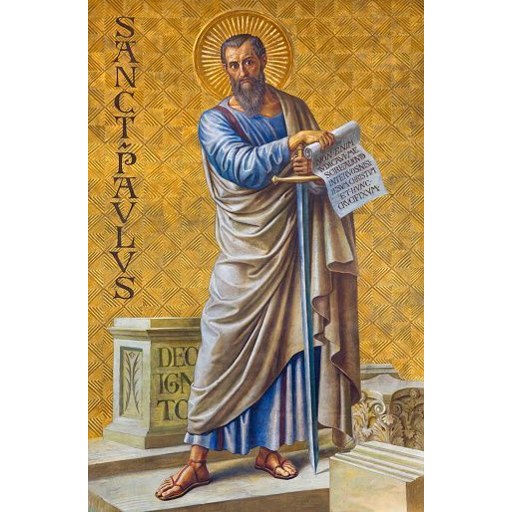
https://www.pinterest.com/ideas/paul-the-apostle-art/949959410756/
License: unknown
Apostle Paul
Saint Apostle- Feast Day
- 29 June (with Saint Peter); 25 January (Conversion of Saint Paul)
- Gender
- male
- Church
- Catholic
Places
Roles & Family
Patronage
missionaries;theologians;evangelists;tentmakers;Malta;Rome;Gentile Christians;Cursillo movement;rope makers;saddlers;weavers;against snakebite;Catholic Action;lay apostolate;São Paulo;London;Pontifical Mission Societies
Biography
Paul the Apostle, known also as Saul of Tarsus, was a first-century Jewish Christian missionary and writer whose letters form a substantial portion of the New Testament. He was born in Tarsus, a city in the Roman province of Cilicia in Asia Minor, to a Jewish family of the tribe of Benjamin, and he possessed Roman citizenship by birth. According to the Acts of the Apostles, he was educated in Jerusalem in the Pharisaic tradition under Gamaliel. In his own letters he describes himself as a Hebrew of Hebrews and, as to the law, a Pharisee, and he acknowledges that he had persecuted the early followers of Jesus with great zeal. Acts narrates that he was present at the death of Stephen and that he sought authorization to arrest Christians in Damascus.
While traveling to Damascus, according to Acts and allusions in his letters, Paul experienced a revelatory encounter with the risen Jesus that transformed him from a persecutor into a preacher of the gospel. After a period in Arabia and Damascus, and a later visit to Jerusalem, he undertook extensive missionary journeys across Asia Minor, Macedonia, and Achaia in the mid-first century, founding or strengthening communities in cities including Antioch, Philippi, Thessalonica, Corinth, and Ephesus. He worked at times as a tentmaker to support himself. His mission was directed especially to Gentiles, and he argued that they could belong to the people of God through faith in Christ without taking on the full yoke of the Mosaic Law, a position that brought him into conflict with some Jewish Christians and is reflected in the letter to the Galatians and in Acts’ account of the council at Jerusalem.
Thirteen New Testament epistles are traditionally attributed to Paul. Modern critical scholarship generally accepts seven as authentic—Romans, 1 and 2 Corinthians, Galatians, Philippians, 1 Thessalonians, and Philemon—while the authorship of Ephesians, Colossians, 2 Thessalonians, and the Pastoral Epistles remains debated. These writings develop themes of justification by faith, the death and resurrection of Jesus, the role of the Spirit, the unity of Jew and Gentile in Christ, and practical instruction for community life. They are among the earliest Christian documents and have had an enduring influence on Christian theology in both East and West. In 1 Corinthians he presents himself as unmarried and commends that state, which is the principal documentary basis for regarding him as without a spouse or children.
According to Acts, Paul was arrested in Jerusalem after a riot in the Temple precincts, detained at Caesarea under Roman governors, and, having appealed to the emperor as a Roman citizen, was sent to Rome. The narrative of Acts ends with him under house arrest in the capital, preaching freely. Later first- and second-century Christian writers, including Clement of Rome in the late first century and, subsequently, Eusebius of Caesarea, report that Paul was martyred in Rome during Nero’s persecution of Christians, generally placed in the mid-60s of the first century. Tradition holds that, as a citizen, he was beheaded rather than crucified, and that he was buried along the Ostian Way. The Basilica of Saint Paul Outside the Walls stands over the traditional tomb; a sarcophagus there has been associated with him in modern archaeological investigation.
Paul is venerated as a saint and apostle throughout the historic Christian churches. In the Roman Catholic, Eastern Orthodox, Anglican, and Lutheran calendars he is commemorated with Saint Peter on 29 June; the Conversion of Saint Paul is observed on 25 January. He is invoked as patron of missionaries, theologians, evangelists, tentmakers, and of Malta, among many other causes and places. His interpretation of the gospel for the nations made him, in Christian memory, the Apostle to the Gentiles, and his letters remain central to Christian scripture, preaching, and doctrine.