Apostle Paul is a saint of the Catholic Church. Apostle Paul's feast day is celebrated on 29 June. Apostle Paul is the patron saint of missionaries;theologians;evangelists;preachers;writers;authors;journalists;publishers;tentmakers;rope makers;saddle makers;weavers;Malta;Rome;against snakebites;Cursillo movement;Pontifical Mission Societies;hospitality;public relations workers.
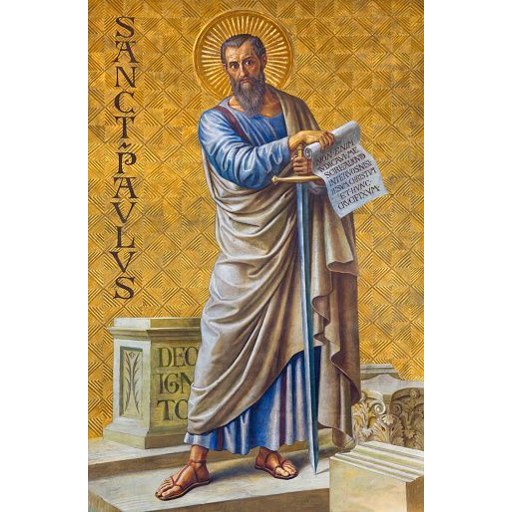
https://www.pinterest.com/ideas/paul-the-apostle-art/949959410756/
License: unknown
Apostle Paul
Saint Apostle- Feast Day
- 29 June
- Gender
- male
- Church
- Catholic
Places
Roles & Family
Patronage
missionaries;theologians;evangelists;preachers;writers;authors;journalists;publishers;tentmakers;rope makers;saddle makers;weavers;Malta;Rome;against snakebites;Cursillo movement;Pontifical Mission Societies;hospitality;public relations workers
Biography
Paul the Apostle, also known as Saul of Tarsus, was a first-century Jewish preacher and missionary whose letters form a substantial portion of the New Testament and whose interpretation of the gospel of Jesus became foundational for Christianity. He was born in Tarsus, a Hellenistic city in the Roman province of Cilicia, to a Jewish family of the tribe of Benjamin, and he was a Roman citizen by birth. According to the Acts of the Apostles he was educated in Jerusalem in the Pharisaic tradition under Gamaliel. In early adulthood he took part in the persecution of the followers of Jesus, an activity he later acknowledged in his own letters; Acts presents him as present at the stoning of Stephen and as obtaining authority to arrest Christians in Damascus.
The turning point of his life is described in Acts and, more briefly, in his letters: while traveling to Damascus he experienced a revelation of the risen Christ, after which he was baptized and began to proclaim that Jesus was the Messiah. He spent a period in Arabia and Damascus, later visiting Jerusalem, and eventually worked from Antioch in Syria, which became a base for missionary activity among Gentiles. Together with Barnabas and later with Silas and others he traveled through Cyprus, Asia Minor, Macedonia, and Greece, founding communities in cities such as Philippi, Thessalonica, Corinth, and Ephesus. He argued that Gentile converts need not observe the full Mosaic law, a position that provoked controversy and that was addressed at the council of Jerusalem described in Acts and reflected in the letter to the Galatians.
A substantial body of letters attributed to Paul survives in the New Testament. Scholars generally regard Romans, 1 and 2 Corinthians, Galatians, Philippians, 1 Thessalonians, and Philemon as authentically Pauline; the authorship of 2 Thessalonians, Colossians, Ephesians, and the Pastoral Epistles (1-2 Timothy and Titus) is disputed. These writings develop themes of justification, the role of the law, the unity of Jew and Gentile in Christ, and the expected return of Christ, and they remain central to Christian theology. After a final visit to Jerusalem, Paul was arrested following a riot in the Temple and held for two years at Caesarea. As a Roman citizen he appealed to the emperor and was sent to Rome, surviving a shipwreck on Malta according to Acts. Acts ends with Paul under house arrest in Rome, preaching for two years.
Later Christian tradition, already alluded to in 1 Clement near the end of the first century, holds that Paul was martyred in Rome during the reign of Nero, commonly placed in the mid-60s of the first century. He is said to have been beheaded, as befitted a Roman citizen, on the Ostian Way, and to have been buried nearby; the Basilica of Saint Paul Outside the Walls stands over the traditional tomb. He was never the object of a formal medieval canonization process, being venerated as an apostle from the earliest Christian generations. His principal feast, shared with the Apostle Peter, is kept on 29 June; the Conversion of Saint Paul is observed on 25 January. He is widely invoked as a patron of missionaries, theologians, and evangelists, and of the island of Malta.