Apostle Paul is a saint of the Catholic Church. Apostle Paul's feast day is celebrated on 29 June; 25 January (Conversion). Apostle Paul is the patron saint of missionaries;theologians;evangelists;tentmakers;Malta;Rome;London;weavers;rope makers;against snakes;Cursillo movement;Gentile Christians.
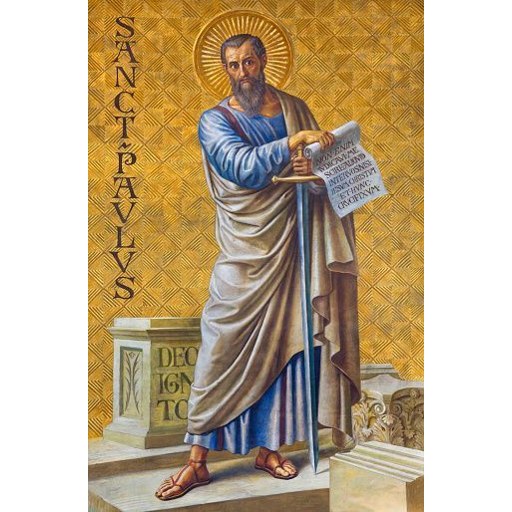
https://www.pinterest.com/ideas/paul-the-apostle-art/949959410756/
License: unknown
Apostle Paul
Saint Apostle- Feast Day
- 29 June; 25 January (Conversion)
- Gender
- male
- Church
- Catholic
Places
Roles & Family
Patronage
missionaries;theologians;evangelists;tentmakers;Malta;Rome;London;weavers;rope makers;against snakes;Cursillo movement;Gentile Christians
Biography
Paul the Apostle, known in life as Saul and remembered as Saint Paul, was a first-century Jewish Christian missionary and theologian whose letters form a substantial part of the New Testament. According to the Acts of the Apostles he was born in Tarsus in Cilicia, of the tribe of Benjamin, and held Roman citizenship by birth. He was raised in the Pharisaic tradition; Acts states that he was educated in Jerusalem under Gamaliel. In his own letters he describes himself as a Hebrew of Hebrews, a Pharisee zealous for the ancestral law, and as one who had persecuted the church of God. Acts portrays him as consenting to the killing of Stephen and as later seeking letters of authorization to arrest followers of Jesus in Damascus. Neither his letters nor Acts give a precise year of birth; modern estimates commonly place it in the first decade of the first century, but no contemporary record confirms an exact date.
The decisive event of his life was the experience he himself calls a revelation of the risen Jesus, which Acts locates on the road to Damascus and which scholars generally date to the mid-30s of the first century. After this turning he spent time in Arabia and Damascus, then went up to Jerusalem, and later worked in the regions of Syria and Cilicia. From Antioch he undertook, with Barnabas and others, missionary travel through Cyprus and southern Asia Minor. Further journeys, reconstructed from Acts together with the letters, carried him through Asia Minor, Macedonia, and Achaia. Communities associated with his preaching arose in Philippi, Thessalonica, Corinth, Ephesus, and elsewhere. He insisted that Gentile believers were not bound to the full Mosaic law, a claim that produced sharp conflict with some Jewish Christians and that was debated at the meeting in Jerusalem often called the Apostolic Council.
The seven letters almost universally accepted as authentic—Romans, 1 and 2 Corinthians, Galatians, Philippians, 1 Thessalonians, and Philemon—are the earliest surviving Christian documents and the principal source for his thought and circumstances. In them he develops a theology of justification by faith in Christ rather than by works of the law, of the Spirit’s indwelling, of the church as Christ’s body, and of an expected imminent return of the Lord. He writes as a pastor confronting faction, immorality, and questions of table fellowship, and as a laborer who supported himself by tentmaking. He also records imprisonments, beatings, a stoning, and shipwreck. Other New Testament writings traditionally ascribed to him (Ephesians, Colossians, 2 Thessalonians, the Pastoral Epistles) are treated by many modern scholars as later compositions in his name; the historical Paul of the undisputed letters remains the figure most securely recoverable.
Acts narrates his arrest in Jerusalem after a riot in the Temple, a prolonged detention at Caesarea under successive Roman governors, and, following an appeal to Caesar, a voyage to Rome that ended in shipwreck on Malta and eventual arrival in the capital, where he lived under house arrest. The canonical narrative does not describe his death. Near the end of the first century, 1 Clement alludes to Paul’s martyrdom after he had reached “the limits of the west.” Later tradition, already current in the second century and reported by Eusebius, holds that he was beheaded at Rome during the Neronian persecution in the mid-60s and buried on the Ostian Way. The Constantinian basilica that became Saint Paul Outside the Walls was built over the site long venerated as his tomb; a sarcophagus beneath the papal altar has been the object of modern archaeological investigation.
From the earliest Christian generations Paul was honored as apostle to the Gentiles and as a principal interpreter of the gospel. His feast is kept with that of Saint Peter on 29 June in East and West; the Conversion of Saint Paul is observed on 25 January. He is invoked as patron of missionaries, theologians, evangelists, tentmakers and related crafts, of Malta (by reason of the shipwreck tradition), and, with Peter, of the city of Rome; London also claims him as patron. No later pope formally canonized him: his cult belongs to the apostolic age itself. Precise years of birth and death remain unknown; what can be said with confidence rests on the letters, on Acts read with critical caution, and on the early second-century memory of his martyrdom at Rome.