Apostle Peter is a saint of the Catholic Church. Apostle Peter's feast day is celebrated on 29 June. Apostle Peter is the patron saint of fishermen;net makers;shipwrights;sailors;locksmiths;the Papacy;Rome;popes;the Catholic Church;bridge builders.
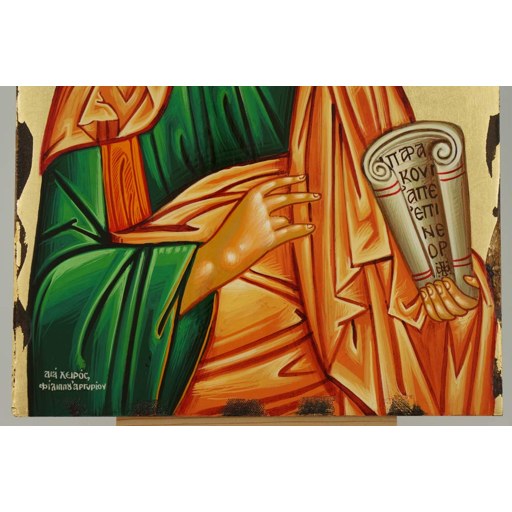
https://blessedmart.com/shop/hand-painted-icons/male-saints-icons/st-peter-the-apostle-icon
License: unknown
Apostle Peter
Saint Apostle- Feast Day
- 29 June
- Gender
- male
- Church
- Catholic
Places
Roles & Family
Patronage
fishermen;net makers;shipwrights;sailors;locksmiths;the Papacy;Rome;popes;the Catholic Church;bridge builders
Biography
Simon, son of Jonah or John, known in the New Testament as Peter or Cephas, was a Galilean Jewish fisherman. The Gospel of John names Bethsaida as the city of Andrew and Peter; the Synoptic Gospels associate him with a household in Capernaum, where Jesus healed his mother-in-law, a detail that shows he was married. Paul later wrote that Cephas was accompanied by a believing wife. Peter and his brother Andrew were among the first called from their nets. Jesus gave Simon the Aramaic name Kepha, meaning rock, rendered in Greek as Petros. With James and John he formed an inner group among the Twelve, present at events from which the other disciples were excluded, including the Transfiguration and the agony in Gethsemane.
The Gospels portray him as prominent and impulsive. He confessed Jesus as the Messiah at Caesarea Philippi; in Matthew, Jesus then called him the rock on which the church would be built and spoke of the keys of the kingdom. All four Gospels record his threefold denial during the Passion; John and a tradition in Luke describe a later restoration. After the crucifixion the New Testament presents Peter as a leading resurrection witness and as the chief public figure of the earliest Jerusalem community. In Acts he preaches at Pentecost, heals in Jesus' name, appears before the Sanhedrin, and, through the baptism of the Roman centurion Cornelius, is linked to the inclusion of Gentiles. He was imprisoned under Herod Agrippa I and, according to Acts, released. At the Council of Jerusalem he argued that Gentile converts need not be circumcised. Paul's letter to the Galatians records a dispute at Antioch over table fellowship between Jewish and Gentile Christians.
Christian writers of the late first and second centuries, including the author of 1 Clement, Ignatius of Antioch, and Irenaeus of Lyons, associate Peter with Rome. Tradition holds that he led the church there and was executed in the Neronian persecution after the fire of Rome, in the mid-60s of the first century. An early tradition, reported by Origen and Eusebius and elaborated in the apocryphal Acts of Peter, states that he was crucified upside down at his own request. He was believed to have been buried on the Vatican hill near the Circus of Nero. A memorial shrine stood there by the late second century; Constantine built a basilica over the site in the fourth century. The present St. Peter's Basilica occupies that location. Twentieth-century excavations uncovered early Christian burials and a shrine consistent with the ancient claim, though identification of particular remains remains debated among historians and archaeologists.
In Catholic teaching Peter is the first Bishop of Rome and first pope. Eastern churches likewise regard him as the first bishop of Antioch, from which the patriarchate of that city traces its succession. His principal feast, shared with the Apostle Paul, is 29 June; other commemorations include the Chair of Saint Peter. He is invoked as patron of fishermen, net makers, shipwrights, sailors, locksmiths, the papacy, and the city of Rome, among other causes and places. Two New Testament letters bear his name. First Peter is often connected with a first-century Petrine circle in Rome; the authorship of Second Peter is widely regarded by modern scholars as later. Whatever the later development of papal and patriarchal claims, the New Testament and the earliest extra-biblical Christian literature agree in placing Peter among the foremost leaders of the Jesus movement in the decades after the crucifixion.