Apostle Peter is a saint of the Catholic Church. Apostle Peter's feast day is celebrated on 29 June. Apostle Peter is the patron saint of fishermen;net makers;shipwrights;locksmiths;cobblers;clock makers;bakers;butchers;harvesters;bridge builders;the Papacy;popes;Rome;against fever;against frenzy;foot problems;longevity.
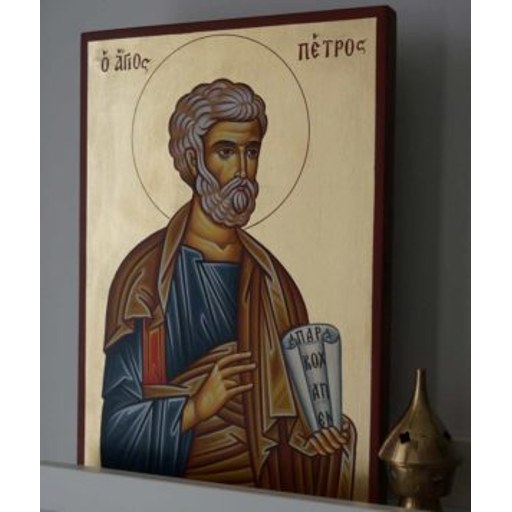
https://blessedmart.com/shop/orthodox-icons/saints-icons/st-peter-icon
License: unknown
Apostle Peter
Saint Apostle- Feast Day
- 29 June
- Gender
- male
- Church
- Catholic
Places
Roles & Family
Patronage
fishermen;net makers;shipwrights;locksmiths;cobblers;clock makers;bakers;butchers;harvesters;bridge builders;the Papacy;popes;Rome;against fever;against frenzy;foot problems;longevity
Biography
Saint Peter, known in the New Testament as Simon or Simeon and given the name Cephas (Aramaic for "rock"; Greek Petros), was a Jewish fisherman from Bethsaida in Galilee and the brother of the apostle Andrew. The Gospels present him as the son of Jonah or John and as a resident of Capernaum, where Jesus healed his mother-in-law, indicating that Peter was married. Jesus called Simon and Andrew from their work on the Sea of Galilee; Simon thereafter belonged to the inner group of disciples, present at the Transfiguration, the raising of Jairus's daughter, and the agony in Gethsemane. At Caesarea Philippi he confessed Jesus as the Messiah and Son of the living God; in Matthew's account Jesus responded that Peter was the rock on which the church would be built and entrusted him with the keys of the kingdom. The same Gospels record Peter's threefold denial of Jesus during the passion and a corresponding threefold restoration after the resurrection.
In the Acts of the Apostles Peter appears as a leading figure of the Jerusalem community in the years after Jesus' death. He preached at Pentecost, was associated with healings and with conflict and imprisonment under Herodian and Jewish authorities, and, after a vision at Joppa, authorized the baptism of the Gentile centurion Cornelius—an episode of lasting importance for the inclusion of non-Jews. Paul's letter to the Galatians describes a confrontation at Antioch over table fellowship with Gentiles, showing Peter's continuing role and the tensions of the early mission. The First Epistle of Peter, if accepted as connected with the apostle, is written from "Babylon," a designation early Christians commonly applied to Rome.
From the late first and second centuries, Christian writers including Clement of Rome, Ignatius of Antioch, Dionysius of Corinth, Irenaeus, and later Eusebius of Caesarea attest a tradition that Peter ministered in Rome and died there as a martyr. He is also remembered as the first bishop of Antioch, and later patriarchal lists of that see begin with his name. The martyrdom is placed in the reign of Nero, in the context of the persecution that followed the fire of Rome in the mid-60s of the first century. Later tradition, found in the apocryphal Acts of Peter and reported by Origen as cited in Eusebius, holds that Peter was crucified and that he asked to be placed on the cross head downward, deeming himself unworthy of the same death as his Lord. A shrine on the Vatican hill was already pointed out in the second century; Constantine built a basilica over the site in the fourth century. Excavations in the twentieth century beneath the present St. Peter's Basilica revealed a first-century cemetery and a tropaion long associated with the apostle's tomb. The Catholic Church venerates the relics beneath the papal altar as those of Peter.
Peter is honored throughout the Christian world as proto-apostle. The Catholic Church regards him as the first Bishop of Rome and first pope; the churches of the East commemorate him as chief of the apostles and as founder of the see of Antioch. His principal feast, shared with Saint Paul, falls on 29 June and is of great antiquity in Rome. Other observances include the Chair of Saint Peter. He is invoked as patron of fishermen and of many related crafts, of the papacy and of the city of Rome, and against various illnesses. Almost nothing can be established about the year of his birth; the New Testament and the earliest extra-biblical witnesses remain the primary sources for his life, and many later legends cannot be verified.