Apostle Peter is a saint of the Catholic Church. Apostle Peter's feast day is celebrated on 29 June. Apostle Peter is the patron saint of fishermen;net makers;shipbuilders;sailors;the Papacy;Rome;locksmiths;cobblers;shoemakers;clockmakers;masons;bakers;butchers;harvesters;bridge builders;against fever;longevity.
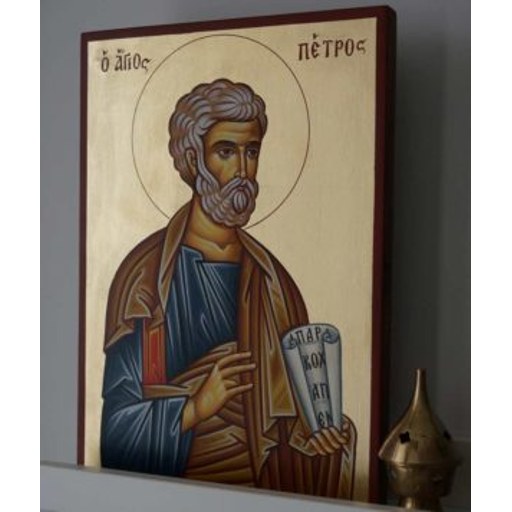
https://blessedmart.com/shop/orthodox-icons/saints-icons/st-peter-icon
License: unknown
Apostle Peter
Saint Apostle- Feast Day
- 29 June
- Gender
- male
- Church
- Catholic
Places
Roles & Family
Patronage
fishermen;net makers;shipbuilders;sailors;the Papacy;Rome;locksmiths;cobblers;shoemakers;clockmakers;masons;bakers;butchers;harvesters;bridge builders;against fever;longevity
Biography
Simon, later called Peter (Greek Petros, rendering Aramaic Kepha, “rock”), was a Jewish fisherman from Galilee in the early first century CE and one of the Twelve Apostles of Jesus of Nazareth. The Gospel of John identifies Bethsaida as the city of Andrew and Peter; the Synoptic Gospels associate him with a household in Capernaum on the Sea of Galilee, where Jesus healed his mother-in-law. That episode, together with Paul’s remark in 1 Corinthians that Cephas travelled with a believing wife, shows that Peter was married. The New Testament names his father Jonah or John. Called from his nets with his brother Andrew and with James and John, he belonged to Jesus’ inner circle and is portrayed as spokesman for the disciples. At Caesarea Philippi he confessed Jesus as Messiah; in Matthew’s account Jesus named him Peter and spoke of building the church upon this rock and of the keys of the kingdom. He appears at the Transfiguration and in Gethsemane. All four Gospels record that he denied Jesus three times during the Passion and wept afterward; John 21 describes a threefold restoration after the resurrection.
In the Acts of the Apostles Peter is the leading figure of the earliest Jerusalem community. He interprets the events of Pentecost, heals in Jesus’ name, defends the apostles before the Sanhedrin, and, after a vision at Joppa, baptizes the Gentile centurion Cornelius, a turning point for the inclusion of non-Jews. Acts also recounts his imprisonment under Herod Agrippa I and a miraculous release. At the Council of Jerusalem he argues that Gentile converts need not be circumcised. Paul’s letter to the Galatians, however, describes a clash at Antioch in which Paul rebuked Peter for withdrawing from table fellowship with Gentiles under pressure from men associated with James. Two New Testament letters bear Peter’s name. First Peter was accepted as Petrine in the early church, though modern critics debate its authorship; Second Peter is widely regarded by critical scholars as later and pseudonymous. Extra-canonical works such as the Gospel of Peter, the Apocalypse of Peter, and the Acts of Peter circulated in the second century and afterward but were not received into the New Testament canon.
From the late first century, Christian writers associate Peter with Rome. The First Letter of Clement, written from Rome toward the end of that century, refers to Peter’s struggles and death. Ignatius of Antioch, Dionysius of Corinth, Irenaeus of Lyons, and the Roman presbyter Gaius (quoted by Eusebius of Caesarea) attest a Petrine sojourn and martyrdom in the city. Eusebius, citing Origen, states that Peter was crucified; the apocryphal Acts of Peter add the request to be crucified head downward as unworthy to die in the same manner as Jesus. These traditions are commonly linked to Nero’s persecution after the fire of Rome in the mid-60s of the first century, though no contemporary source records an exact year. Gaius pointed to memorial “trophies” of the apostles on the Vatican Hill and on the Ostian Way. Constantine built a basilica over the Vatican shrine; the present Saint Peter’s Basilica stands on that site. Twentieth-century excavations beneath it uncovered a second-century tropaion and a complex of graves. Identification of particular bones as Peter’s remains a matter of both archaeological debate and religious tradition.
In later Christian memory Peter became the type of the apostle, the forgiven denier, and, in Catholic teaching, the first Bishop of Rome. Eastern churches honor him as chief of the apostles while understanding primacy in conciliar rather than monarchical terms, and they also preserve the tradition that he was first bishop of Antioch before going to Rome. His principal liturgical feast, shared with the Apostle Paul, is 29 June; the Chair of Saint Peter is commemorated separately in the Roman calendar. He is invoked as patron of fishermen and of trades connected with the sea, of locksmiths, cobblers, and other crafts, of the city of Rome and of the papacy. Later hagiography elaborated his life with legends—the Quo vadis meeting on the Appian Way, the fall of Simon Magus, a daughter sometimes named Petronilla—whose historical basis cannot be verified from early reliable sources. What can be said with confidence from the New Testament and from second-century testimony is that a Galilean fisherman named Simon became a central witness to Jesus, a leader of the first Jewish-Christian community, and, according to a broad and early consensus, a martyr in Rome whose tomb was venerated on the Vatican Hill.