Apostle Peter is a saint of the Catholic Church. Apostle Peter's feast day is celebrated on 29 June. Apostle Peter is the patron saint of fishermen;net makers;shipwrights;the Papacy;Rome;the Universal Church;popes;locksmiths;cobblers;bridge builders;clockmakers;watchmakers;bakers;butchers;harvesters;masons;stationers;against fever;against frenzy.
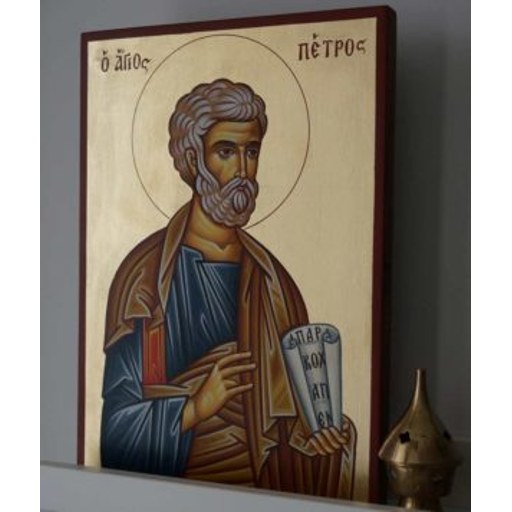
https://blessedmart.com/shop/orthodox-icons/saints-icons/st-peter-icon
License: unknown
Apostle Peter
Saint Apostle- Feast Day
- 29 June
- Gender
- male
- Church
- Catholic
Places
Roles & Family
Patronage
fishermen;net makers;shipwrights;the Papacy;Rome;the Universal Church;popes;locksmiths;cobblers;bridge builders;clockmakers;watchmakers;bakers;butchers;harvesters;masons;stationers;against fever;against frenzy
Biography
Simon, later called Peter (Greek Petros, “rock,” rendering the Aramaic Kepha or Cephas), was a Jewish fisherman associated in the New Testament with Bethsaida in Galilee and with Capernaum on the Sea of Galilee. He was the brother of the apostle Andrew. The Gospels present him among the first disciples called by Jesus of Nazareth; he left his nets to follow, and Capernaum, where Jesus is said to have healed Peter’s mother-in-law, served as a base for the Galilean ministry. That healing is the principal New Testament evidence that Peter was married. Clement of Alexandria, writing in the late second or early third century, further states that Peter had children and that he later saw his wife led away to death. The wife’s name is not recorded in the canonical texts or in that early patristic notice. In the Gospel narratives Peter is the most frequently named of the Twelve: spokesman for the disciples, present at the Transfiguration and in Gethsemane, the disciple who walked on the water and then faltered, and the one who three times denied Jesus before the crucifixion and was afterward restored. Matthew 16:18–19 attributes to Jesus the saying that Peter is the rock on which the church would be built and that he would receive the keys of the kingdom; the historical meaning of that passage became central to later claims of Roman primacy, while Eastern tradition has often read it in a more collegial or confessional sense.
After the crucifixion and the experiences the early community described as resurrection appearances, the Book of Acts portrays Peter as a principal leader of the Jerusalem church: preaching at Pentecost, associated with healings, and taking part in the decision that Gentile converts need not be circumcised, commonly identified with the so-called Council of Jerusalem. Paul’s letter to the Galatians records a sharp confrontation at Antioch over table fellowship with Gentiles, indicating both Peter’s authority and the tensions of the first-generation mission. Two New Testament epistles bear Peter’s name. Most critical scholars regard 2 Peter as pseudonymous and many also question whether 1 Peter is directly from the apostle, though both documents reflect Petrine tradition and were received as such in the churches. A large body of apocryphal acts, gospels, and apocalypses associated with Peter circulated in the second and later centuries; they are historically valuable as evidence of devotion and legend rather than as straightforward biography.
Early Christian writers from the late first century onward (1 Clement, Ignatius of Antioch, Irenaeus, Dionysius of Corinth, the Roman presbyter Gaius, Tertullian, and later Eusebius of Caesarea) attest the tradition that Peter went to Rome, exercised leadership in the Roman church, and was martyred there under Nero. The death is usually placed in the persecution that followed the fire of Rome in 64, though some later Eastern notices prefer a date near the end of Nero’s reign. The New Testament itself does not describe the martyrdom. Later legend, especially the Acts of Peter, holds that he was crucified upside down at his own request; that detail is not independently verified in the earliest sources. A tomb venerated as Peter’s on the Vatican Hill was already the site of a shrine by the second century. Constantine built the first St. Peter’s basilica over that cemetery; twentieth-century excavations confirmed an early cult site beneath the present high altar, though the identification of particular bones remains debated among historians and is not required for the antiquity of the cult.
In Catholic succession lists Peter is the first Bishop of Rome and thus the first pope. Eastern tradition also counts him as the first bishop of Antioch, later styled patriarch of that see, which likewise claims a Petrine foundation. Because he belongs to the apostolic age, there was no medieval or modern process of beatification or canonization; veneration is continuous from the earliest Christian centuries. His principal feast, shared with Paul, is 29 June; other commemorations include the Chair of Peter. He is patron of fishermen and of many related crafts and trades, of the city of Rome, of the papacy and the Universal Church, and of a range of causes including locksmiths, cobblers, bridge builders, and those suffering from fever. His historical outline—Galilean fisherman, leading disciple, Jerusalem and Antiochene missionary, and Roman martyr—is unusually well anchored for a first-century figure, even while precise years of birth and death, the name of his wife, and many later legendary episodes remain beyond verification.