Apostle Peter is a saint of the Catholic Church. Apostle Peter's feast day is celebrated on 29 June. Apostle Peter is the patron saint of fishermen;net makers;shipbuilders;sailors;locksmiths;the Papacy;Rome;bakers;butchers;clock makers;watchmakers;cobblers;bridge builders;harvesters;stationers;longevity;fever;frenzy.
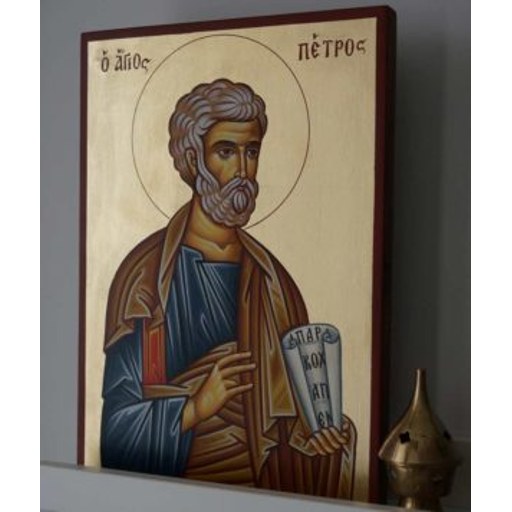
https://blessedmart.com/shop/orthodox-icons/saints-icons/st-peter-icon
License: unknown
Apostle Peter
Saint Apostle- Feast Day
- 29 June
- Gender
- male
- Church
- Catholic
Places
Roles & Family
Patronage
fishermen;net makers;shipbuilders;sailors;locksmiths;the Papacy;Rome;bakers;butchers;clock makers;watchmakers;cobblers;bridge builders;harvesters;stationers;longevity;fever;frenzy
Biography
Simon, later called Peter (Aramaic Kepha, Greek Petros, both meaning “rock”), was a first-century Jewish fisherman from Bethsaida in Galilee and the brother of the apostle Andrew. The Gospels associate him with work on the Sea of Galilee, at times in partnership with James and John the sons of Zebedee, and with a household in Capernaum, where Jesus healed his mother-in-law—an episode that, together with Paul’s remark in 1 Corinthians that Cephas was accompanied by a believing wife, shows that he was married. Clement of Alexandria later wrote that Peter had children, though neither the name of his wife nor those of any children are preserved in early, reliable sources. According to the Johannine and Synoptic traditions, Andrew brought Simon to Jesus, who renamed him and called him from his nets to become a “fisher of people.” Thereafter he belonged to the innermost circle of the Twelve.
In the Gospel narratives Peter functions as spokesman of the disciples. With James and John he is present at the raising of Jairus’s daughter, the Transfiguration, and the agony in Gethsemane. Matthew records his confession at Caesarea Philippi that Jesus is the Messiah and Son of God, the saying that on this rock the church would be built, and the conferral of the keys of the kingdom. The same tradition, however, also preserves his rebukes and misunderstandings, his attempt to turn Jesus aside from the passion, and his threefold denial in the high priest’s courtyard, followed by bitter weeping. The Fourth Gospel adds the restorative scene by the Sea of Tiberias in which the risen Jesus three times questions Peter’s love and charges him to feed and tend the flock.
After Pentecost, the Acts of the Apostles presents Peter as the leading public figure of the Jerusalem community: preacher of the first Christian sermon, worker of signs, spokesman before the Sanhedrin, and the apostle through whom the Gentile Cornelius and his household were received into the church. He was imprisoned under Herod Agrippa I and, according to Acts, miraculously released. Paul’s letter to the Galatians attests both Peter’s recognized apostleship to the circumcised and a sharp confrontation at Antioch over table fellowship with Gentiles. Early Christian tradition, already reflected in the late first-century First Epistle of Clement and in second-century writers, holds that he subsequently exercised ministry at Antioch—where later episcopal lists of that see name him as founding bishop—and then at Rome.
Ancient tradition, accepted by most historians as at least broadly historical, places Peter’s martyrdom in Rome during the reign of Nero, in the period of the persecution that followed the fire of 64 or in the years immediately afterward. Later sources, including Origen as cited by Eusebius, report that he was crucified and that he asked to be fixed to the cross head-downward, judging himself unworthy to die in the same manner as his Lord. He was said to have been buried on the Vatican hill beside the Circus of Gaius and Nero. By the late second century a tropaion or memorial marked the site, as the Roman presbyter Gaius reported; Constantine’s basilica and the present St. Peter’s were raised over that cemetery. Twentieth-century excavations uncovered a first-century necropolis and a tropaion consistent with the ancient claims, though identification of particular remains remains a matter of interpretation.
Peter’s place in the New Testament (including 1 Peter, whose Petrine origin is often accepted at least in a broad sense, and 2 Peter, which is more widely regarded as later) and the large body of subsequent Petrine literature made him the pre-eminent apostolic figure of the Western church and a principal saint of the East. He is commemorated with Paul on 29 June and, in the Roman calendar, also by the feasts of the Chair of Peter and the Dedication of the Basilicas of Peter and Paul. Regarded as the first Bishop of Rome and, in Eastern succession lists, as the first bishop of Antioch, he became patron of the papacy, of the city of Rome, of fishermen and related crafts, and of numerous other causes. His cult is among the oldest in Christianity, and the tomb under the Vatican basilica has been a major pilgrimage site since late antiquity.