Apostle Peter is a saint of the Catholic Church. Apostle Peter's feast day is celebrated on 29 June. Apostle Peter is the patron saint of fishermen;net makers;shipbuilders;sailors;locksmiths;the Papacy;Rome;bridge builders;clockmakers;cobblers;harvesters;stationers;bakers;the Universal Church;against fever;longevity.
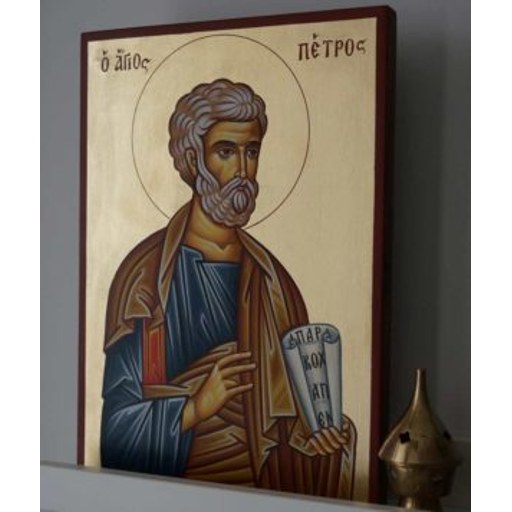
https://blessedmart.com/shop/orthodox-icons/saints-icons/st-peter-icon
License: unknown
Apostle Peter
Saint Apostle- Feast Day
- 29 June
- Gender
- male
- Church
- Catholic
Places
Roles & Family
Patronage
fishermen;net makers;shipbuilders;sailors;locksmiths;the Papacy;Rome;bridge builders;clockmakers;cobblers;harvesters;stationers;bakers;the Universal Church;against fever;longevity
Biography
Simon, later called Peter, was a first-century Jewish fisherman from Bethsaida in Galilee, identified in the New Testament as the son of Jonah (or John) and the brother of the apostle Andrew. The Gospel of John states that Bethsaida was the city of Andrew and Peter and that Andrew brought Simon to Jesus, who named him Cephas, an Aramaic word meaning rock, rendered in Greek as Petros. The Synoptic Gospels describe Jesus calling Simon and Andrew from their work by the Sea of Galilee. Capernaum figures as an early centre of the household: the Gospels record that Jesus healed Peter’s mother-in-law there, which is the principal New Testament evidence that Peter was married. Paul’s First Letter to the Corinthians later refers to Cephas as travelling with a believing wife. No contemporary source preserves the wife’s name.
In the Gospel narratives Peter is listed first among the Twelve and is present at decisive moments, including the Transfiguration and the scene in Gethsemane. At Caesarea Philippi he confesses Jesus as the Messiah; Matthew’s account adds Jesus’ saying that Peter is the rock on which the church will be built and that he will receive the keys of the kingdom, a passage central to later Catholic teaching on the Petrine office. The same tradition records his threefold denial during the Passion and, in the appendix to John’s Gospel, a threefold restoration in which the risen Jesus charges him to feed his sheep. These episodes have long been read together as portraying both failure and restored leadership.
The Acts of the Apostles presents Peter as the leading figure of the Jerusalem community in the years after Jesus’ death: he speaks at Pentecost, is associated with early healings and public testimony, and plays a decisive role in the admission of Gentiles, especially in the account of the centurion Cornelius. Paul, writing to the Galatians, calls Cephas a pillar of the Jerusalem church and describes a dispute with him at Antioch over table fellowship with Gentile believers. Ancient Christian writers, including Origen and Eusebius of Caesarea, report that Peter was a leader of the church in Antioch. The Orthodox and other Eastern lists of bishops of Antioch therefore begin with him, which is the basis for regarding him as first patriarch of that see, even though the later title of patriarch did not exist in the first century. The First Epistle of Peter, whether by Peter or written in his name, addresses Christians in Asia Minor and sends greetings from “Babylon,” a designation early Christian authors commonly took to mean Rome.
The New Testament does not describe Peter’s death. A late first-century letter from the church of Rome known as 1 Clement speaks of Peter’s witness and departure, and second- and third-century writers—including Ignatius of Antioch, Dionysius of Corinth as cited by Eusebius, Irenaeus, Tertullian, and Gaius of Rome—treat Peter’s ministry and martyrdom in Rome as established tradition. Later legendary narratives, notably the apocryphal Acts of Peter, add the detail of crucifixion upside down under Nero; those embellishments are not historically secure, but they cohere with a death during the Neronian persecution of Christians in Rome in the mid-60s of the first century. Catholic tradition identifies him as the first bishop of Rome and therefore the first pope. From late antiquity a grave on the Vatican hill was venerated as his tomb; Constantine’s basilica and the present St. Peter’s Basilica were built over that site. His principal feast, shared with the apostle Paul, is 29 June; the Chair of Saint Peter is also kept on 22 February.