Apostle Peter is a saint of the Catholic Church. Apostle Peter's feast day is celebrated on 29 June. Apostle Peter is the patron saint of fishermen;netmakers;shipwrights;sailors;locksmiths;cobblers;shoemakers;clockmakers;watchmakers;stonemasons;masons;bakers;butchers;harvesters;bridge builders;stationers;the Papacy;popes;Rome;against fever;against frenzy;foot problems;longevity;Saint Petersburg;Poznań;Trier;Chartres;Cologne;Worms;Philadelphia.
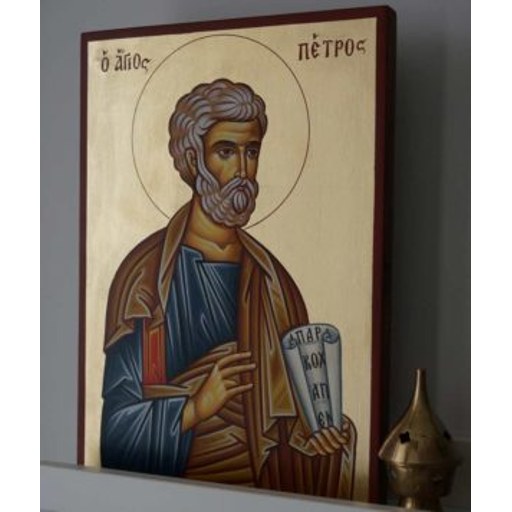
https://blessedmart.com/shop/orthodox-icons/saints-icons/st-peter-icon
License: unknown
Apostle Peter
Saint Apostle- Feast Day
- 29 June
- Gender
- male
- Church
- Catholic
Places
Roles & Family
Patronage
fishermen;netmakers;shipwrights;sailors;locksmiths;cobblers;shoemakers;clockmakers;watchmakers;stonemasons;masons;bakers;butchers;harvesters;bridge builders;stationers;the Papacy;popes;Rome;against fever;against frenzy;foot problems;longevity;Saint Petersburg;Poznań;Trier;Chartres;Cologne;Worms;Philadelphia
Biography
Simon, later called Peter, was a Galilean Jewish fisherman of the early first century, the son of a man named Jonah or John and the brother of the apostle Andrew. The Gospel of John identifies Bethsaida, on the northern shore of the Sea of Galilee, as the city of Andrew and Peter, while the Synoptic Gospels place his household in nearby Capernaum, where Jesus healed Peter's mother-in-law of a fever. That episode, together with Paul's remark in First Corinthians that Cephas was accompanied by a believing wife, establishes that Peter was married. Clement of Alexandria, writing around the turn of the third century, further states that Peter had children. Jesus gave him the Aramaic name Kepha, meaning rock, which appears in Greek as Cephas and in Latin as Petrus. The Gospels present him as among the first called: he and Andrew left their fishing nets at Jesus' invitation and became disciples, and Peter is named first in every New Testament list of the Twelve Apostles.
Within the Gospel tradition Peter belongs to a smaller circle, with James and John, who witness the raising of Jairus's daughter, the Transfiguration, and Jesus' agony in Gethsemane. At Caesarea Philippi he confesses Jesus as the Messiah, the Son of the living God; in Matthew's Gospel Jesus responds that he will build his church upon this rock and will give Peter the keys of the kingdom of heaven. The same narratives record Peter's attempt to walk on the water, his rebuke of Jesus' prediction of the Passion, his presence at the arrest, and his threefold denial in the high priest's courtyard. After the resurrection, the Gospel of John describes a threefold restoration in which the risen Christ asks Peter whether he loves him and commissions him to feed and tend the flock. These texts became the principal scriptural basis for later Christian teaching on Peter's primacy among the apostles.
In the Acts of the Apostles Peter appears as the leading public figure of the earliest Jerusalem community. He preaches at Pentecost, performs healings in Jesus' name, speaks before the Jewish council, and, in the conversion of the Roman centurion Cornelius at Caesarea, authorizes the admission of uncircumcised Gentiles. Paul, writing to the Galatians, calls Cephas a pillar of the Jerusalem church and recounts a dispute with him at Antioch over whether Jewish and Gentile believers should share table fellowship. The New Testament does not provide a connected itinerary of Peter's later years. A greeting from Babylon at the close of First Peter has been understood since antiquity as a reference to Rome. Second-century Christian writers, including Ignatius of Antioch, Dionysius of Corinth, Irenaeus of Lyons, and Clement of Alexandria, associate Peter with the churches of Antioch and of Rome and treat him as a founding authority in both.
Ecclesiastical tradition from the late first century onward holds that Peter went to Rome, exercised pastoral leadership there, and was put to death during the persecution under the emperor Nero, in the period following the great fire of Rome in the mid-60s of the first century. Ancient sources do not agree on a single calendar year; later writers place the martyrdom variously in the mid-60s. The apocryphal Acts of Peter and later historians such as Eusebius of Caesarea, who cites Origen, report that Peter was crucified and that he asked to be crucified upside down because he judged himself unworthy to die in the same posture as Jesus. A grave on the Vatican hill, beneath the present high altar of St. Peter's Basilica, has been the object of Christian veneration since at least the second century. Excavations in the twentieth century uncovered a second-century memorial shrine at that spot; the identification of bones found nearby with the apostle remains a matter of tradition and scholarly discussion rather than of uncontested archaeological proof.
Peter is honored as the first bishop of Rome and, in the Catholic Church, as the first pope. The Orthodox and Oriental Orthodox churches likewise venerate him as the chief of the apostles and as the founder of the church of Antioch, of which traditional patriarchal lists name him the first occupant. His principal feast, shared with the apostle Paul, is celebrated on 29 June; other commemorations include the Chair of Saint Peter. He is invoked as patron of fishermen, net makers, shipwrights and sailors, of locksmiths and those who work with keys, of cobblers, masons, bakers and numerous other trades, of the papacy and of the city of Rome, and of many other places and causes. In Christian art he is commonly shown with keys, a fishing boat, a rooster, or an inverted cross, images drawn from the Gospels and from the traditions of his martyrdom.