Apostle Peter is a saint of the Catholic Church. Apostle Peter's feast day is celebrated on 29 June. Apostle Peter is the patron saint of fishermen;net makers;shipwrights;sailors;locksmiths;popes;the Papacy;Rome;the Catholic Church;bakers;butchers;clockmakers;cobblers;harvesters;stonemasons;bridge builders;against fever.
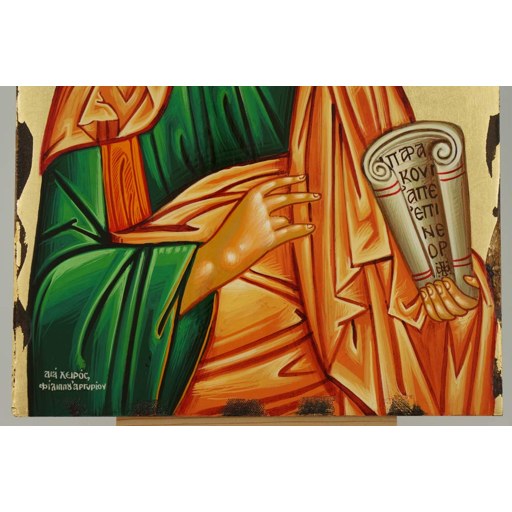
https://blessedmart.com/shop/hand-painted-icons/male-saints-icons/st-peter-the-apostle-icon
License: unknown
Apostle Peter
Saint Apostle- Feast Day
- 29 June
- Gender
- male
- Church
- Catholic
Places
Roles & Family
Patronage
fishermen;net makers;shipwrights;sailors;locksmiths;popes;the Papacy;Rome;the Catholic Church;bakers;butchers;clockmakers;cobblers;harvesters;stonemasons;bridge builders;against fever
Biography
Simon, later called Peter (Greek Petros, rendering the Aramaic Kepha, meaning rock), was a Galilean Jewish fisherman of the early first century. The Gospel of John names Bethsaida as the city of Andrew and Peter; the Synoptic Gospels associate him with a household in Capernaum, where Jesus healed his mother-in-law, a notice that also shows he was married. He is identified as son of Jonah or John and as brother of the apostle Andrew, who according to John first brought him to Jesus. Called from his work on the Sea of Galilee, he became one of the Twelve and, with James and John, belonged to the innermost group of disciples. In Matthew’s account Jesus gives him the name Peter and the saying about the rock and the keys of the kingdom, a passage that later tradition made central to claims of Petrine authority in the church.
In the Gospel narratives Peter often speaks for the Twelve. He confesses Jesus as Messiah at Caesarea Philippi, is present at the Transfiguration, and is among those taken into Gethsemane. The same sources record his threefold denial of Jesus during the Passion and a subsequent restoration; the Gospel of John depicts the risen Christ charging him to tend and feed the flock. After Pentecost, the Acts of the Apostles presents him as the leading public figure of the Jerusalem community in its earliest years: preaching, healing, facing imprisonment, and, in the conversion of the Gentile Cornelius at Caesarea, authorizing a decisive opening to non-Jews. He appears at the Jerusalem meeting that addressed Gentile converts. Paul’s letter to the Galatians independently attests Peter’s standing in Jerusalem and a later confrontation at Antioch over table fellowship with Gentiles. First Corinthians notes that Cephas, like other apostles, was known to travel with a believing wife. Clement of Alexandria, writing in the late second or early third century, reports the tradition that Peter had children and that his wife suffered martyrdom.
By the late second century, Irenaeus of Lyons, Tertullian, and a Roman presbyter named Gaius (cited by Eusebius of Caesarea) report that Peter preached in Rome and was martyred there. First Clement, a letter from the Roman church at the end of the first century, already alludes to Peter’s witness and death. The martyrdom is placed in the reign of Nero and is commonly connected with the persecution that followed the fire of Rome in 64, though some later ecclesiastical writers give a date around 67. A tradition recorded by Origen and transmitted by Eusebius holds that Peter was crucified head downward at his own request. He was buried on the Vatican hill beside the circus of Gaius and Nero. A second-century tropaion already marked the site; excavations under the present St. Peter’s Basilica in the twentieth century uncovered a necropolis and a shrine consistent with early veneration of that grave.
Christian tradition counts Peter as the first Bishop of Rome, and thus the first pope in the Catholic succession, and also as founder of the church of Antioch, later one of the patriarchal sees of the East. Two New Testament epistles bear his name; ancient churches received First Peter widely, while the authorship of Second Peter has long been discussed among scholars. His principal feast, shared with the Apostle Paul, is kept on 29 June; the Chair of Peter is commemorated separately. He is invoked as patron of fishermen and of crafts tied to nets, ships, keys, and locks, of the city of Rome, and of the papacy. Veneration of his tomb on the Vatican has been continuous from late antiquity, and the basilica that bears his name stands over the traditional burial place.