Apostle Peter is a saint of the Catholic Church. Apostle Peter's feast day is celebrated on 29 June. Apostle Peter is the patron saint of fishermen;net makers;shipbuilders;sailors;locksmiths;bridge builders;clockmakers;watchmakers;cobblers;harvesters;bakers;butchers;stationers;the Papacy;Rome;longevity;against fever;foot ailments.
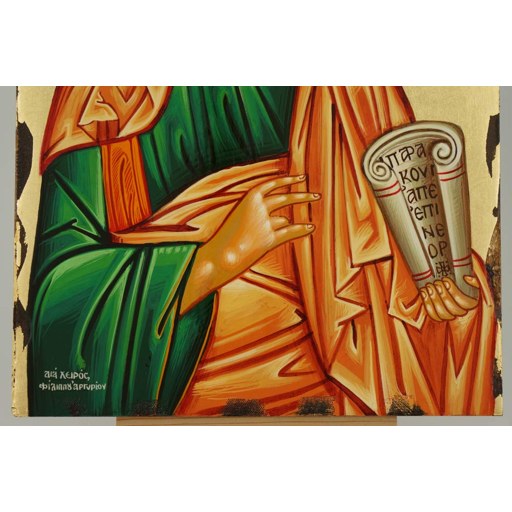
https://blessedmart.com/shop/hand-painted-icons/male-saints-icons/st-peter-the-apostle-icon
License: unknown
Apostle Peter
Saint Apostle- Feast Day
- 29 June
- Gender
- male
- Church
- Catholic
Places
Roles & Family
Patronage
fishermen;net makers;shipbuilders;sailors;locksmiths;bridge builders;clockmakers;watchmakers;cobblers;harvesters;bakers;butchers;stationers;the Papacy;Rome;longevity;against fever;foot ailments
Biography
Simon, later known as Peter (Greek Petros, rendering the Aramaic Kepha, 'rock'), was a Jewish fisherman of Galilee in the early first century. The Gospel of John identifies Bethsaida as the hometown of Peter and his brother Andrew; the Synoptic Gospels associate his household with Capernaum on the Sea of Galilee, where Jesus healed Peter's mother-in-law, a notice that also establishes that Peter was married. First Corinthians independently attests that he travelled with a believing wife. Called from his nets together with Andrew, James, and John, he became one of the Twelve Apostles and, in the New Testament portrayal, the most prominent of them. Jesus gave him the name Cephas/Peter and, in Matthew's Gospel, the saying about the rock and the keys of the kingdom, a text later central to claims of Petrine authority in Rome and elsewhere.
Within the Gospel narratives Peter belongs to an inner group present at the Transfiguration and at the raising of Jairus's daughter, and he is depicted as both impulsive and fallible: he walks on the water and then falters; he confesses Jesus as the Messiah at Caesarea Philippi and is rebuked when he rejects the prediction of the Passion; he vows loyalty and then denies Jesus three times before the crucifixion. The Fourth Gospel records a threefold restoration after the Resurrection. These scenes, together with appearance traditions in which Peter is named first among the witnesses, established his standing in early Christian memory. Clement of Alexandria, writing in the late second century, states that Peter had children and recounts a tradition that his wife was led to martyrdom.
The Acts of the Apostles presents Peter as the leading figure of the Jerusalem community in the years after Jesus's death: he preaches at Pentecost, performs healings, and, after a vision at Joppa, baptizes the Gentile centurion Cornelius, an episode the narrative treats as decisive for the inclusion of non-Jews. He is imprisoned under Herod Agrippa I and, according to Acts, miraculously released. At the council in Jerusalem he argues that Gentile converts need not be burdened with the full yoke of the Mosaic Law. Paul's letter to the Galatians, a firsthand source from the mid-first century, attests both Peter's authority in Jerusalem and Antioch and a sharp dispute at Antioch over table fellowship with Gentiles. First Corinthians mentions a Cephas party at Corinth, indicating a wide missionary reach already in the fifties of the first century. Later lists of the bishops of Antioch count Peter as the first occupant of that see, which became a patriarchal throne in the Christian East.
Later Christian writers of the late first and second centuries, among them the author of 1 Clement, Ignatius of Antioch, and Dionysius of Corinth, associate Peter with Rome and with martyrdom. Second-century and subsequent tradition holds that he was executed in Rome during the persecution under Nero in the mid-60s of the first century. Origen, as cited by Eusebius of Caesarea, reports that Peter asked to be crucified head downward, deeming himself unworthy to die in the same manner as Jesus; the apocryphal Acts of Peter elaborates this story. He was believed to have been buried on the Vatican hill beside the Circus of Nero. A shrine existed there by the second century, and Constantine's basilica, later replaced by the present St. Peter's, was built over the site. Twentieth-century excavations beneath the basilica uncovered a mid-second-century tropaion and a grave that many Catholic authorities identified with the traditional tomb, though scholarly debate on the identification continues.
From antiquity Peter has been commemorated as chief of the apostles and, in Roman Catholic ecclesiology, as the first Bishop of Rome and first pope. His principal feast, shared with Paul, is kept on 29 June; the Chair of Peter is observed on 22 February. He is patron of fishermen and of many related crafts, of locksmiths and those who keep keys, of the city of Rome and of the papacy, and of numerous other places and causes. Two New Testament letters bear his name; most critical scholars regard 1 Peter as possibly connected with a Petrine circle in Rome and 2 Peter as a later work. The figure of Peter remains central to Christian art, liturgy, and debates over apostolic authority.