Apostle Peter is a saint of the Catholic Church. Apostle Peter's feast day is celebrated on 29 June. Apostle Peter is the patron saint of fishermen;net makers;shipwrights;sailors;the Papacy;popes;Rome;the Catholic Church;locksmiths;cobblers;clockmakers;watchmakers;bakers;butchers;harvesters;masons;bridge builders;stationers;against fever.
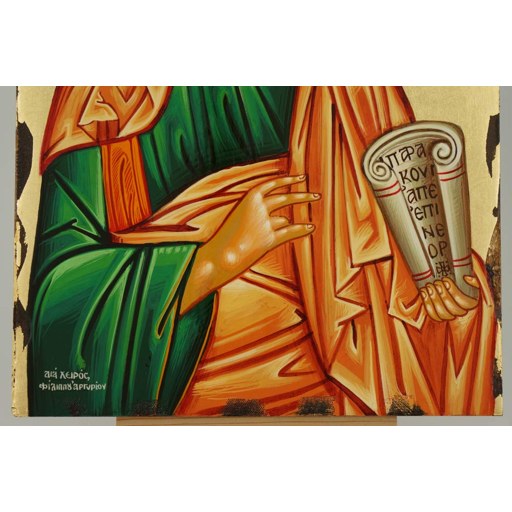
https://blessedmart.com/shop/hand-painted-icons/male-saints-icons/st-peter-the-apostle-icon
License: unknown
Apostle Peter
Saint Apostle- Feast Day
- 29 June
- Gender
- male
- Church
- Catholic
Places
Roles & Family
Patronage
fishermen;net makers;shipwrights;sailors;the Papacy;popes;Rome;the Catholic Church;locksmiths;cobblers;clockmakers;watchmakers;bakers;butchers;harvesters;masons;bridge builders;stationers;against fever
Biography
Simon, later called Peter (Greek Petros, from Aramaic Kepha, meaning rock), was a Jewish fisherman of the early first century from Bethsaida in Galilee. With his brother Andrew he worked the Sea of Galilee and was later associated with a household in Capernaum. The Gospels present him among the first disciples called by Jesus of Nazareth. His original name appears as Simon (or Simeon) son of Jonah or John. That he was married is attested in the Synoptic accounts of Jesus healing his mother-in-law in the Capernaum house (Mark 1:29–31 and parallels) and by Paul, who in the 50s refers to Cephas as taking a believing wife on missionary journeys (1 Corinthians 9:5). Her name is not recorded in the New Testament. Clement of Alexandria, writing in the late second century, states that Peter had children; later legendary cycles name a daughter, but those identifications are not historically secure.
Peter holds a leading place among the Twelve. The Synoptic Gospels group him with James and John in an inner circle present at the raising of Jairus’s daughter, the Transfiguration, and Gethsemane. Matthew 16 records his confession of Jesus as Messiah and the saying about the rock and the keys, which later became central to claims of Petrine primacy in the Roman church. The same narratives portray his impulsiveness, his attempt to walk on the water, his rebuke of Jesus, and his threefold denial during the Passion, followed by a restoration scene in John 21. After the crucifixion and the reported resurrection, the Acts of the Apostles presents him as the principal public spokesman of the Jerusalem community in its earliest years: preaching at Pentecost, performing healings, confronting the Jerusalem authorities, and, in the Cornelius episode of Acts 10–11, opening the mission to Gentiles.
The New Testament does not supply a continuous biography after the Jerusalem meeting described in Acts 15. Paul recounts a confrontation with Cephas at Antioch over table fellowship with Gentile believers (Galatians 2). From the late first century onward, Christian writers associate Peter with missionary work and with the churches of Antioch and Rome. Eusebius, drawing on earlier sources, reports a period as bishop in Antioch before a ministry in Rome. First Clement, commonly dated to the end of the first century, speaks of Peter’s martyrdom after many labors in a context that implies Rome. Second-century witnesses, including Ignatius of Antioch, Dionysius of Corinth, Irenaeus of Lyons, and the Roman presbyter Gaius, attest a Roman sojourn and death. Ancient tradition holds that he was crucified under Nero, often specified as upside down at his own request. The precise year is not independently documented; it is placed in the 60s, frequently in connection with the Neronian persecution after the fire of 64.
Burial was associated from at least the second century with the Vatican hill, near the Circus of Gaius and Nero. Gaius, quoted by Eusebius, referred to Peter’s tropaion on the Vatican. Excavations beneath St. Peter’s Basilica in the twentieth century uncovered a mid-second-century memorial and a grave that had been an object of early veneration, consistent with the literary tradition, though identification of remains cannot be demonstrated with scientific certainty. Catholic tradition regards him as the first Bishop of Rome and first pope; Eastern churches honor him as founder and first bishop of the see of Antioch, later counted among the patriarchs of that church, and as chief of the apostles. He is commemorated with Paul on 29 June in East and West; other observances include the Chair of Saint Peter. He is invoked as patron of fishermen and of trades connected with nets, ships, keys, and stone, and of the city of Rome.