Aquila is a saint of the Catholic Church. Aquila's feast day is celebrated on 8 July (Western); 13 February and 14 July (Eastern Orthodox). Aquila is the patron saint of tentmakers.
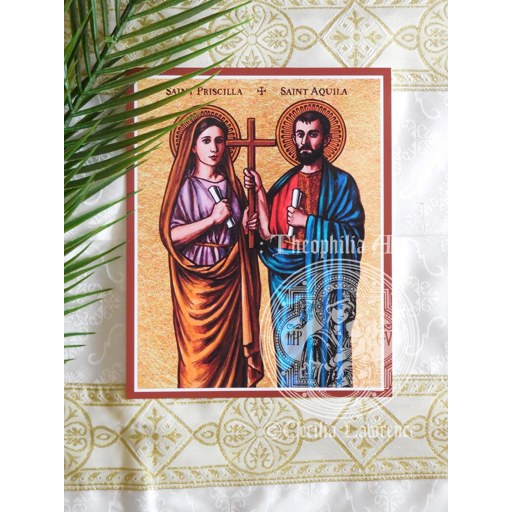
https://www.etsy.com/listing/1540548857/saints-priscilla-and-aquila-icon
License: unknown
Aquila
Saint- Feast Day
- 8 July (Western); 13 February and 14 July (Eastern Orthodox)
- Gender
- male
- Church
- Catholic
Places
Roles & Family
Religious Information
Patronage
tentmakers
Biography
Aquila was a Jewish Christian of the first century, identified in the Acts of the Apostles as a native of Pontus, a region on the southern shore of the Black Sea in Asia Minor. The New Testament presents him always together with his wife Priscilla, also called Prisca. They were tentmakers by trade. According to Acts, they had been living in Italy until the emperor Claudius ordered the Jews to leave Rome. That expulsion is independently noted by the Roman historian Suetonius and is usually placed around the middle of the first century. Driven from the capital, Aquila and Priscilla settled in Corinth, a major commercial city of Achaia. There the apostle Paul, newly arrived from Athens and himself a tentmaker, found them, stayed in their house, and worked alongside them while he preached in the synagogue each Sabbath and subsequently formed a congregation in the city.
Their association with Paul was not merely occupational. After a substantial period of ministry in Corinth, Paul departed for Syria and took Aquila and Priscilla with him as far as Ephesus, where they remained. In Ephesus they met Apollos, a learned Jew from Alexandria who spoke boldly in the synagogue but knew only the baptism of John. Aquila and Priscilla took him aside and explained the way of God more accurately, an incident that shows them as informed and trusted teachers rather than as silent companions of the apostle. Paul's First Letter to the Corinthians, written from Ephesus, sends greetings from Aquila and Prisca together with the church that met in their house, indicating that their home served as a place of Christian assembly. When Paul later wrote to the church in Rome, he greeted Prisca and Aquila as his fellow workers in Christ Jesus, adding that they had risked their necks for his life and that all the churches of the Gentiles gave thanks for them. The couple therefore appear to have returned to Rome after Claudius's death, when the edict would have lapsed. A still later greeting in the Second Letter to Timothy, traditionally associated with Paul's final imprisonment, again mentions Prisca and Aquila, apparently once more in the orbit of Ephesus.
No contemporary source records Aquila's date of birth or death, the city of his death, or his place of burial. Scripture is silent about whether the couple had children. Later ecclesiastical tradition, especially in the Christian East, numbered Aquila among the Seventy Apostles and sometimes styled him a bishop, for instance of Heraclea. Western and Eastern hagiography also produced narratives of martyrdom. These developments cannot be confirmed from first-century evidence and should be regarded as pious elaboration rather than as established biography. What can be said with confidence is that Aquila and Priscilla belonged to the earliest generation of Jewish Christian missionaries, that they combined artisan labor with hospitality and instruction, and that Paul regarded them as colleagues whose courage had preserved his life.
Veneration of the pair is ancient. The Roman Martyrology commemorates Saints Aquila and Priscilla on 8 July. In the Eastern Orthodox Church, Aquila is remembered among the Seventy Apostles on 13 February, and both husband and wife are commemorated on 14 July. They were never the subject of a formal papal canonization of the later medieval or modern type; their cult rests on scriptural witness and continuous liturgical memory. They are not associated with a religious order. In later devotion they have often been invoked by tentmakers and, as a married couple prominent in apostolic work, sometimes by Christian spouses, though such patronages are secondary to the biblical portrait.