Aquilinus of Milan is a saint of the Catholic Church (d. 1015). Aquilinus of Milan's feast day is celebrated on 29 January.
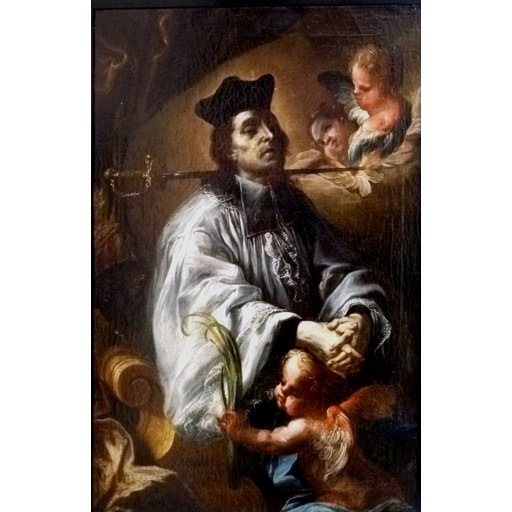
Simon Benedikt Faistenberger
License: CC BY-SA 3.0
Aquilinus of Milan
Saint- Life Span
- d. 1015
- Feast Day
- 29 January
- Gender
- male
- Church
- Catholic
Places
Roles & Family
Canonization
Biography
Aquilinus of Milan, also known in German tradition as Aquilinus of Cologne (Aquilin), is a priest-martyr whose cult is centered on the Basilica of San Lorenzo Maggiore in Milan. The principal later medieval vita presents him as a native of Würzburg in Franconia who received a clerical education and became a canon of the cathedral chapter of Cologne. He was reputed for learning and austerity. According to that tradition he was offered the archiepiscopal see of Cologne and refused it, preferring poverty, pilgrimage, and itinerant preaching to high office. He is described throughout as a secular priest and cathedral canon, not as a member of a religious order, and he is not recorded as having married.
After leaving the Rhineland he is said to have spent time in Paris and then to have traveled into Italy. In Milan he preached against doctrinal error and against moral and disciplinary abuses among the clergy. Later hagiography sometimes names his opponents as Cathars, a designation that belongs more properly to a later period; other accounts speak of Arians. The Roman Martyrology commemorates him on 29 January as a priest of Milan slain with a sword by Arians for the Catholic faith, a formulation that would imply a much earlier date than the eleventh century. A separate strand of tradition places his activity and death in Milan around 1015, in the setting of reform preaching in Lombardy. Independent contemporary documentation of his career is lacking, and modern historians have long noted that the Arian-martyr notice and the German-canon vita sit uneasily together.
The legend of his death holds that he was attacked by opponents of his preaching and mortally wounded by a sword or lance, often specified as a blow to the neck or throat. His body was taken to the Basilica of San Lorenzo Maggiore, one of Milan’s most ancient churches. He is venerated there in the Cappella di Sant’Aquilino, a late antique octagonal structure that originated as a Roman imperial mausoleum of the fourth century and was later dedicated to the saint. Relics associated with him have been kept in that chapel for many centuries. The feast is observed on 29 January.
Historical certainty about Aquilinus remains limited. The coexistence of an early martyrological tradition of an Arian-period priest-martyr at Milan and a later biography of an eleventh-century Franconian canon suggests either conflation of more than one figure or the attachment of a detailed foreign vita to an older local cult. The chapel that bears his name is archaeologically a late Roman building, which has encouraged the view that the Milanese cult is older than the Würzburg–Cologne narrative. He is not recorded as pope or patriarch. Despite the thinness of the contemporary record, veneration of Aquilinus has been continuous in Milan, and the chapel in San Lorenzo remains the principal focus of his memory.