Archbishop Maximianus of Constantinople is a saint of the Catholic Church (d. 434). Archbishop Maximianus of Constantinople's feast day is celebrated on 21 April.
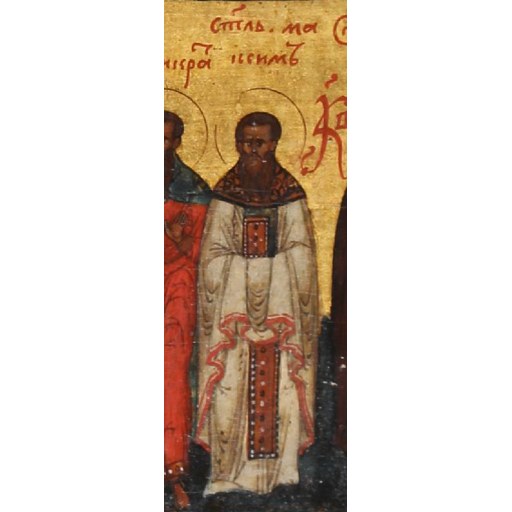
Anonymous Russian icon painter (before 1917)Public domain image (according to PD-Russia-expired)
License: Public domain
Archbishop Maximianus of Constantinople
Saint- Life Span
- d. 434
- Feast Day
- 21 April
- Gender
- male
- Church
- Catholic
Places
Roles & Family
Biography
Maximianus, also known as Maximian, was Archbishop of Constantinople from 25 October 431 until his death on 12 April 434. He assumed the see at one of the most turbulent moments in the history of the imperial church. His predecessor, Nestorius, had been condemned at the First Council of Ephesus in the summer of 431 for teachings associated with a sharp distinction between the divine and human in Christ and for rejecting the title Theotokos for the Virgin Mary. The council, dominated by Cyril of Alexandria and his allies, deposed Nestorius, but the church of Constantinople remained unsettled, and imperial and episcopal politics continued to swirl around the vacant throne. Maximianus was chosen as a figure whose personal holiness and lack of involvement in the most aggressive partisan struggles made him acceptable to the court of Theodosius II and to the anti-Nestorian majority.
Contemporary narrative sources, especially the Church History of Socrates Scholasticus, present Maximianus as a presbyter of Constantinople who had long followed an ascetic and monastic way of life. He is not described as a major theologian, a court orator, or the author of surviving treatises. His reputation rested on piety, simplicity, and orthodoxy rather than on intellectual celebrity. Later hagiographical tradition sometimes calls him a native of Rome, but fifth-century historians do not record his birthplace or the year of his birth, and those details remain uncertain. What is clear is that he was already an established cleric of the capital when he was elected. He was consecrated on 25 October 431. In keeping with custom he sent synodical letters to the other principal sees of Rome, Alexandria, Antioch, and Jerusalem, announcing his elevation and seeking recognition of communion.
The short patriarchate of Maximianus was devoted largely to restoring ecclesiastical order in Constantinople after the Nestorian crisis. He is credited with receiving back into communion persons who had been separated during the conflict, and with supporting the reception of the decrees of Ephesus in the capital. He corresponded with Pope Celestine I of Rome and with Cyril of Alexandria, thereby aligning the see of Constantinople with the Western and Alexandrian interpretation of the council. He does not appear as a leading actor in the subsequent negotiations that would eventually produce the Formula of Reunion of 433 between Cyril and John of Antioch; those diplomatic efforts were carried on by others. Nonetheless, his occupancy of the throne of Constantinople helped prevent a prolonged vacancy or a Nestorian restoration in the city that housed the imperial court.
Maximianus died on 12 April 434, after little more than two years in office. He was succeeded by Proclus, a renowned preacher who had previously been a candidate for the patriarchate and who would later play a notable role in christological controversy. Maximianus left no substantial body of writings that have come down under his name. He is commemorated as a saint in the Eastern Orthodox Church, with his feast commonly observed on 21 April. Because he belongs to the era before formal papal canonization processes, there is no record of a later individual canonizer or beatifier in the medieval Western sense. Historical knowledge of his life remains limited to his clerical status, his ascetic reputation, the circumstances of his election after Ephesus, his brief administration of the Constantinopolitan church, and the date of his death in the capital of the Eastern Roman Empire.