Aristobulus is a saint of the Catholic Church. Aristobulus's feast day is celebrated on March 15.
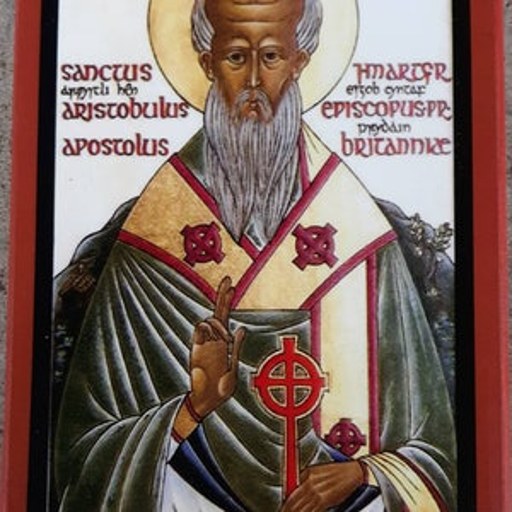
https://www.etsy.com/listing/601224864/icon-of-st-aristobulus-1st-bishop-of
License: unknown
Aristobulus
Saint- Feast Day
- March 15
- Gender
- male
- Church
- Catholic
Roles & Family
Biography
Aristobulus is remembered in Eastern Christian hagiography as one of the Seventy Apostles and as an early missionary bishop associated with Britain. The only New Testament reference to a person of this name in a Christian context is Saint Paul's greeting in Romans 16:10: "Greet those who belong to the household of Aristobulus." The verse does not describe Aristobulus himself as a believer, nor does it locate him outside Rome. Ancient and modern commentators have sometimes connected this household with the Herodian family, noting that a grandson of Herod the Great named Aristobulus lived in the orbit of the imperial court; that identification, if correct, would make the biblical notice a reference to Christian slaves or freedmen of a Jewish prince in Rome rather than to an itinerant apostle. The later church, however, treated the name as that of a disciple of the apostolic generation.
By late antiquity, catalogues of the Seventy Apostles circulating under the names of Hippolytus of Rome and Dorotheus of Tyre listed Aristobulus as bishop of Britain. Those lists are not first-century documents, and their historical value for reconstructing apostolic missions is limited, but they demonstrate that Greek-speaking churches already associated this name with a British episcopate. Orthodox tradition adds that he was a brother of the Apostle Barnabas, that he accompanied or was sent by Saint Paul, and that he preached in several western regions, including Britain and, in some accounts, Spain, founding churches and serving as the island's first bishop. Welsh antiquarian tradition has occasionally linked his name with the district of Arwystli; such links are etymological conjectures rather than documented itineraries.
No contemporary source records his birth, death, or burial. Hagiographical notices place his activity in the first century and his death in Britain, some saying he died in peace after a long ministry and others that he was martyred; none of these claims can be verified, and proposed dates in the later first century are conjectural. He is not known to have been married or to have had children, nor did he belong to a later religious order. He was not Bishop of Rome, nor did he hold a patriarchal see. Veneration of Aristobulus as a saint belongs to the ancient, pre-congregational layer of Christian cult; there is no medieval or modern bull of canonization or beatification of the kind used in the second millennium.
The Eastern Orthodox Church commemorates him on 15 March (in some calendars 16 March) as the Apostle Aristobulus, Bishop of Britain, and again with the college of the Seventy Apostles, especially on 4 January. He has no widely attested official patronages of places, trades, or causes comparable to those of major saints, though he is honored in Orthodox usage as an apostle of the British Isles. Western martyrologies and the historical record of Roman Britain do not independently confirm his mission. The earliest securely attested British bishops appear in the fourth century, at the Council of Arles in 314. The figure of Aristobulus therefore stands at the meeting point of a Pauline greeting, later apostolic lists, and the desire of later churches to ascribe an apostolic origin to Christianity in Britain. A careful account must distinguish that liturgical and legendary memory from what can be known historically, which remains very little.