Arsen Iqaltoeli is a saint of the Catholic Church (d. 1127).
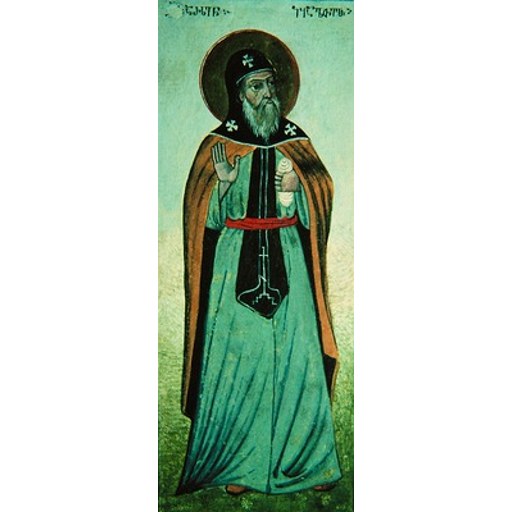
Unknown authorUnknown author
License: Public domain
Arsen Iqaltoeli
Saint- Life Span
- d. 1127
- Gender
- male
- Church
- Catholic
Places
Roles & Family
Canonization
Biography
Arsen Iqaltoeli, known in English as Arsen of Iqalto, was a Georgian Orthodox monk, theologian, translator, and scholar of the late eleventh and early twelfth centuries. He belongs to the generation of Georgian churchmen who, after study and monastic life in the Byzantine world, returned to the Caucasus to support the ecclesiastical and cultural programme of King David IV, called the Builder. His epithet Iqaltoeli associates him with Iqalto in Kakheti, in eastern Georgia, and later tradition treats him as a native of that place and as the organizer of its monastic school. No surviving source records a year of birth, and the names of his parents and the circumstances of his childhood are unknown. What can be reconstructed of his career comes chiefly from later Georgian literary tradition, from his translations, and from his connection with dated events such as the Council of Ruisi-Urbnisi.
In his youth Arsen sought advanced learning in the Byzantine Empire. He is described as having studied in Constantinople, including at the intellectual centre attached to the Monastery of Saint George of Mangana, and as having lived among the Georgian monks of the Iviron Monastery on Mount Athos. Iviron was then the principal Georgian house on the Holy Mountain and the seat of a major translation school. Through that Athonite and Constantinopolitan training he became a competent Hellenist and calligrapher, inheriting the programme begun by Euthymius the Athonite and George the Hagiorite, whose versions had already made a large body of Greek patristic, hagiographic, and liturgical literature available in Georgian.
Arsen returned to Georgia during the reign of David IV (1089–1125), when the king was consolidating the realm after Seljuk invasions and reforming the church. He took part in the Council of Ruisi-Urbnisi, convened in 1103, which deposed unworthy bishops, restricted hereditary noble claims upon episcopal sees, and sought to restore canonical order. Georgian tradition ascribes to him the foundation or revival of the academy at Iqalto Monastery in Kakheti. That school, often mentioned together with the academy at Gelati in western Georgia, is presented as a centre of theological and philosophical instruction in the sacred sciences and in the rhetorical culture of the Orthodox world. Whether he served formally as its first rector cannot be confirmed in detail, but his name remained attached to the house.
His principal contribution to Georgian literature was translation from Greek. He produced a Georgian version of the Great Nomocanon, the Byzantine compilation of conciliar canons and imperial laws affecting the church, thereby giving the Georgian Church a fuller legal corpus in its own language. He is also credited with the Dogmaticon, a collection of dogmatic and polemical texts assembled for teaching and for the refutation of heresy. These works belong to the wider effort of David IV’s age to furnish a reunited Georgian kingdom with the canonical, theological, and educational instruments of Byzantine Orthodoxy while remaining a distinct national church. Tradition also remembers Arsen as a copyist, though few manuscripts can be attributed to his hand with certainty.
Arsen is conventionally said to have died in 1127. The exact place of his death and the site of his burial are not firmly established in the sources, though later piety associates him with Iqalto. He is venerated as a saint by the Georgian Orthodox Church. Modern knowledge of him remains limited: no full contemporary vita survives, and much of the narrative of his life has been pieced together from his translations, from notices of the Ruisi-Urbnisi council, and from the later reputation of the Iqalto academy. He is nonetheless a representative figure of the Georgian Athonite diaspora that returned home to serve the monarchy and the church in the early twelfth century.