Arsenius the Great is a saint of the Catholic Church (350 - 445). Arsenius the Great's feast day is celebrated on 8 May (Eastern Orthodox); 19 July (Roman Catholic); 13 Pashons (Coptic Orthodox).
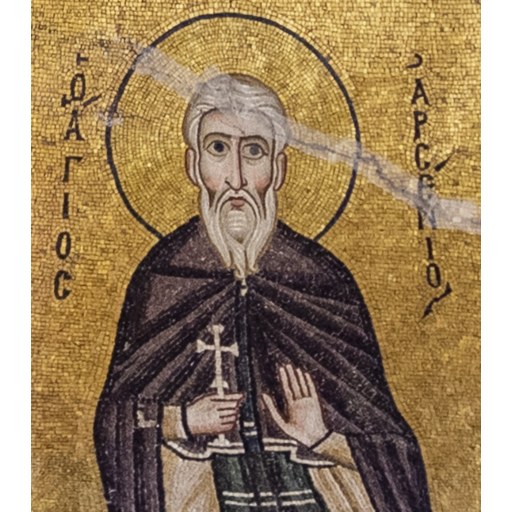
AnonymousUnknown author
License: Public domain
Arsenius the Great
Saint- Life Span
- 350 - 445 (age 95)
- Feast Day
- 8 May (Eastern Orthodox); 19 July (Roman Catholic); 13 Pashons (Coptic Orthodox)
- Gender
- male
- Church
- Catholic
Places
Roles & Family
Canonization
Biography
Arsenius the Great, also called Arsenius of Scetis and Turah or Arsenius the Roman, was one of the most celebrated of the Desert Fathers of late antique Egypt. He was born in Rome in the mid-fourth century into a family of senatorial rank and received a thorough education in Greek and Latin letters. Later tradition, including the notices preserved in the collections of monastic sayings, presents him as a man of high culture who had served the Roman Church, sometimes described as a deacon. When the emperor Theodosius I sought a tutor of learning and character for his sons Arcadius and Honorius, Arsenius was sent to the imperial court at Constantinople. There, according to the hagiographical accounts, he lived for about a decade in a position of honor and material comfort, instructing the young princes while remaining inwardly restless.
Around the last decade of the fourth century, the tradition records that Arsenius heard a divine voice commanding him to flee from men if he wished to be saved. He left the court in secret, made his way to Alexandria, and then withdrew into the desert of Scetis (Wadi El Natrun) in Egypt. He placed himself under the spiritual direction of Abba John the Dwarf (John Colobos) and took up the eremitical life. Despite his former rank and education, he insisted on remaining a beginner in the desert, once remarking that he had not yet learned the alphabet of monastic wisdom. He became known for prolonged silence, severe fasting and vigil, manual labor, and tears of compunction so constant that later writers claimed he always kept a cloth at hand and that his eyelashes were worn away by weeping.
Many of his apophthegms were gathered in the Apophthegmata Patrum and related collections. He is remembered for the saying that he had often regretted having spoken but never regretted having kept silent, and for a fierce determination to avoid celebrity and interruption. When relatives, including a sister who traveled from Rome, sought him out, he refused to see them, holding that such meetings would undo the solitude he had chosen. Visitors and younger monks found him austere and sometimes forbidding; he would not readily interrupt prayer or work for conversation. At the same time the sayings portray a man of deep humility who judged his own former life at court more harshly than any observer could, and who continued to weep over it in old age.
The peace of Scetis was broken by raids of the Mazices and other desert peoples. A devastating attack around the first decade of the fifth century scattered the monks; Arsenius took refuge for a time at places such as Canopus before returning. A further raid around the 430s again drove him from Scetis. In his last years he settled at Troe (Tura), near Memphis in Egypt, and continued the same hidden, penitential life. Traditional chronology places his death there in the mid-fifth century, after some four decades as a monk following his departure from the world. He left no formal rule and founded no order; his influence passed through oral teaching, the written sayings, and the example of withdrawal, silence, and repentance.
Arsenius was venerated as a saint from an early date in the churches of Egypt, the Greek East, and the Latin West. He belongs to the ancient saints recognized by liturgical commemoration rather than by a later papal process of canonization. He is kept on 8 May in the Eastern Orthodox calendar, on 19 July in the Roman Martyrology, and on 13 Pashons in the Coptic Orthodox calendar. His life remains a principal witness to the Roman and Constantinopolitan background of some of the Desert Fathers and to the ideal of radical flight from the world that shaped Egyptian monasticism in the fourth and fifth centuries.