Arsenius is a saint of the Eastern Orthodox Church (1697 - 1772). Arsenius's feast day is celebrated on 28 February.
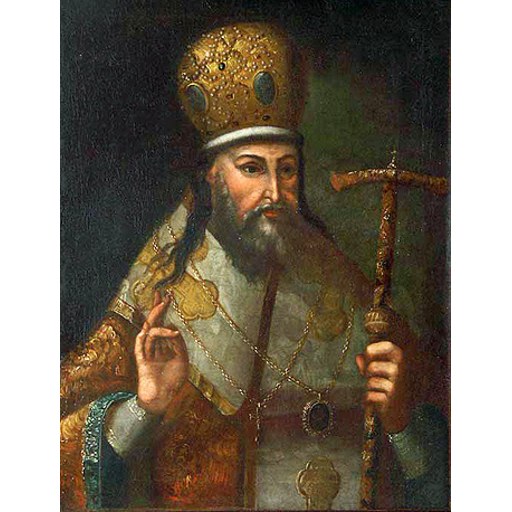
Unknown authorUnknown author
License: Public domain
Arsenius
Saint- Life Span
- 1697 - 1772 (age 75)
- Feast Day
- 28 February
- Gender
- male
- Church
- Eastern Orthodox
Places
Relics & Where to Venerate
Location unknown
The bodily remains of Arsenius are a first-class relic. Venerated at Tallinn.
Roles & Family
Canonization
Biography
Arsenius Matsievich, known in the world as Alexander Matsievich, was an eighteenth-century hierarch of the Russian Orthodox Church who served as Metropolitan of Rostov and Yaroslavl and was later glorified as a hieromartyr. He was born in 1697 in Vladimir-Volynsky in Volhynia, then within the Polish-Lithuanian Commonwealth, into an Orthodox priestly family. He studied at the Kiev Mohyla Academy, the principal Orthodox theological school of the East Slavic world in that period, and afterward entered monastic life, receiving the name Arsenius. Following ordination he worked as a preacher and teacher. In the 1730s he served in Siberia in connection with the diocese of Tobolsk, taking part in pastoral and missionary work on the eastern frontier of the Russian Empire.
In 1741 he was consecrated bishop of Pereyaslav. In 1742 Empress Elizabeth Petrovna appointed him metropolitan of the ancient see of Rostov and Yaroslavl. During roughly two decades in that office he was regarded as a learned and strict hierarch, concerned with the education of the clergy, monastic discipline, and the defense of Orthodox teaching against Protestant, Catholic Uniate, and sectarian influences. He also resisted secular encroachments on church property and jurisdiction, a stance that later brought him into open conflict with the throne.
After Catherine II’s accession, the imperial government in the early 1760s carried out a general secularization of monastic and episcopal estates. Arsenius submitted written protests to the Holy Synod, arguing that the alienation of church lands violated the canons and the duties of a Christian sovereign. In 1763 he was arrested, brought to Moscow, and tried by a synodal court, which deprived him of his episcopal rank and reduced him to the status of a simple monk. He was confined first at the Nikolo-Korelsky Monastery in the far north. Subsequent remarks critical of the empress’s church policy led, in 1767, to a harsher sentence: he was stripped of his monastic status, given the derisive civil name Andrey Vral (Andrew the Liar), and imprisoned in a casemate of the fortress at Revel (present-day Tallinn) in the Baltic provinces.
He died in that confinement on 28 February 1772. For more than two centuries his memory was kept among those who regarded him as a confessor who had suffered for the rights of the Church. In August 2000 the Jubilee Bishops’ Council of the Russian Orthodox Church glorified him as a hieromartyr. His principal feast is kept on 28 February according to the Julian calendar, and he is also commemorated among the saints of Rostov.