Athanasius of Brest-Litovsk is a saint of the Eastern Orthodox Church (d. 1648). Athanasius of Brest-Litovsk's feast day is celebrated on 5 September and 20 July.
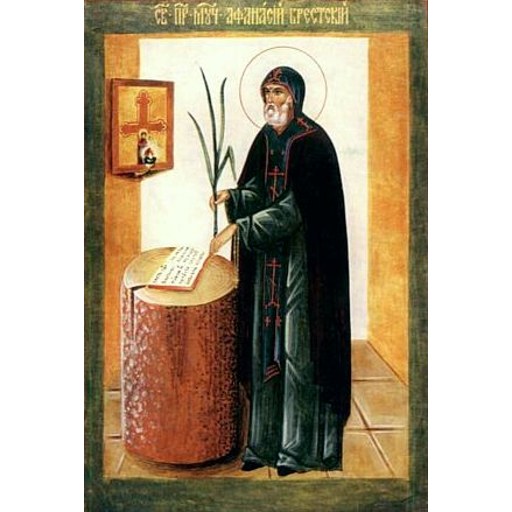
AnonymousUnknown author
License: Public domain
Athanasius of Brest-Litovsk
Saint- Life Span
- d. 1648
- Feast Day
- 5 September and 20 July
- Gender
- male
- Church
- Eastern Orthodox
Places
Relics & Where to Venerate
Location unknown
The bodily remains of Athanasius of Brest-Litovsk are a first-class relic. Venerated at Brest.
Roles & Family
Canonization
Biography
Athanasius of Brest-Litovsk, known in East Slavic sources as Afanasy Brestsky or Afanasy Filipovich, was a seventeenth-century Eastern Orthodox hieromonk, abbot, and martyr whose life was bound up with the defence of Orthodoxy in the Ruthenian lands of the Polish-Lithuanian Commonwealth after the Union of Brest of 1596. Traditional hagiographical accounts assign his birth to about 1597, but contemporary documentation of his parentage and exact birthplace has not survived; he is generally described as coming from a pious Orthodox family, possibly of the lesser nobility or urban milieu of the Brest region in the Grand Duchy of Lithuania. He obtained an education unusual among Orthodox clergy of the borderlands, acquiring Church Slavonic, Polish, Latin, and Greek, and for a time served as a teacher. Orthodox brotherhood schools, founded to counter Jesuit and Uniate educational influence, formed the likely setting of his early intellectual formation.
In the 1620s Athanasius entered the Kupyatitsky Monastery of the Dormition in the Pinsk district, where he received the monastic tonsure and was later ordained hieromonk. The monastery housed the Kupyatitskaya Icon of the Mother of God, a local object of pilgrimage. Athanasius’s own writings, especially the autobiographical Diariusz, recount visions connected with this icon and a sense of divine commission to seek aid for the oppressed Orthodox of the Commonwealth, including appeals directed toward Muscovy. In 1640 he was named hegumen of the Monastery of Saint Simeon the Stylite in Brest-Litovsk. From that office he became one of the most outspoken Orthodox critics of the Union of Brest, which had subordinated a large part of the Ruthenian hierarchy to the Roman pontiff while preserving the Byzantine rite. He regarded the Union as a betrayal of the faith and as a vehicle for the seizure of Orthodox churches and monasteries.
Athanasius repeatedly petitioned King Władysław IV Vasa and other Commonwealth officials to restore Orthodox rights and to halt Uniate and Latin encroachment. He travelled to Warsaw, presented memorials, and preached against the Union in Brest itself, at times in circumstances that Uniate and Catholic authorities treated as public disorder. These efforts brought a series of arrests in the 1640s. He was imprisoned in Warsaw and elsewhere and spent a period under constraint associated with the Kiev Caves Lavra. His surviving texts mix polemic, visionary narrative, and a diary of his imprisonments; they remain a primary source for Orthodox life and inter-confessional conflict in the mid-seventeenth-century Commonwealth. His refusal to moderate his language or to accept the Uniate hierarchy made him a marked man among the local Catholic nobility and the Uniate clergy of Podlasie and Polesie.
In 1648 the Khmelnytsky Uprising erupted in the Ukrainian lands, and Orthodox unrest spread westward. Athanasius was arrested in Brest by Polish authorities, who accused him of encouraging Cossack arms and of inflaming the Orthodox population. On 5 September 1648 he was taken from confinement to a forested place outside the city, shot with a musket, and then beheaded. His body was recovered and interred at the Monastery of Saint Simeon. In 1649 the remains were reported incorrupt, and a local cult of the hieromartyr took shape. The Eastern Orthodox Church glorified him as a saint and martyr; he is commemorated on 5 September, the date of his death, and on 20 July, in connection with the uncovering of his relics. Veneration has been especially strong among the Orthodox of Belarus and in the Russian Orthodox tradition, where he is remembered as a confessor of Orthodoxy against the Union of Brest.