Augustal Prefect Artemius is a saint of the Catholic Church (d. 362). Augustal Prefect Artemius's feast day is celebrated on October 20. Augustal Prefect Artemius is the patron saint of hernias.
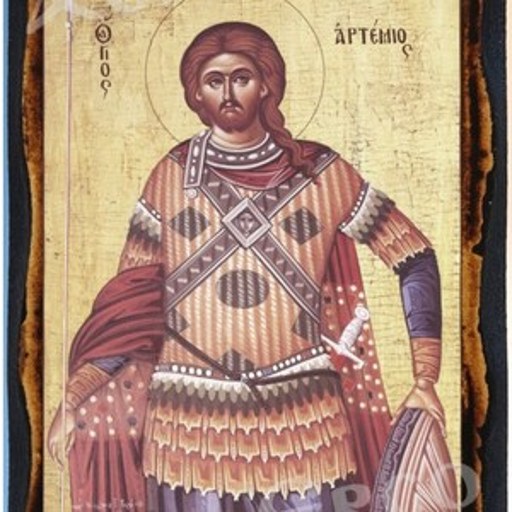
https://www.etsy.com/market/saint_artemius_icon
License: unknown
Augustal Prefect Artemius
Saint- Life Span
- d. 362
- Feast Day
- October 20
- Gender
- male
- Church
- Catholic
Places
Roles & Family
Patronage
hernias
Biography
Artemius, remembered in hagiographical tradition as an Augustal prefect and identified in contemporary historical sources as dux Aegypti, was a senior Roman official of the mid-fourth century. He served under the emperor Constantius II and held military command in Egypt around the year 360. A committed Christian in an era when imperial policy still shifted between Nicene and Arian alignments, he used his authority in ways that later pagan critics regarded as destructive of traditional cults. Neither the date nor the place of his birth is recorded in surviving sources, and nothing reliable is known of his family or early life.
Ecclesiastical historians associate Artemius with the translation of important apostolic relics to Constantinople. According to the Arian historian Philostorgius, whose work survives in an epitome by Photius, Artemius was charged by Constantius II with bringing the remains of Saint Andrew and Saint Luke from Achaia and of Saint Timothy from Ephesus to the imperial capital. In Egypt he became entangled in the violent religious conflicts of Alexandria. Pagan opinion, reflected in later writers and in the circle of the emperor Julian, held him responsible for the desecration of temples and images. Accusers also linked him with the unpopular Arian bishop George of Cappadocia, who was murdered by a pagan mob in Alexandria in late 361 after news arrived of Constantius's death.
When Julian became sole emperor, he reversed the religious policy of his predecessors and gave a hearing to those who had suffered under Christian officials. Artemius was summoned from Egypt to Antioch, where Julian held court in 362. The later Passion of Artemius describes a confrontation in which Artemius refused to offer sacrifice and defended his earlier actions against idols; he was subjected to prolonged torture and finally beheaded. Independent testimony in Ammianus Marcellinus confirms that Artemius, the former military commander of Egypt, was put to death at this time, though Ammianus frames the execution in terms of Julian's justice against an official accused of maladministration and of supporting George's excesses, rather than as a purely religious martyrdom. The year generally assigned to his death is 362.
After the execution, hagiographical tradition relates that a woman named Ariste obtained the body and conveyed it to Constantinople. A cult developed around the relics. By the seventh century a collection of miracle stories, the Miracula Sancti Artemii, recorded healings attributed to him, above all of hernias and related abdominal and genital ailments, at a shrine connected with the church of Saint John the Baptist in the Oxeia district of Constantinople. The Eastern Orthodox Church honors him as the Great Martyr Artemius on 20 October; the Roman Martyrology commemorates him on the same date as an imperial prefect martyred at Antioch under Julian. No formal process of canonization by a named pope is recorded, his cult belonging to the ancient layer of martyr veneration.
Modern historians distinguish the sparse contemporary evidence from the later legendary passion. The Passion of Artemius, which includes lengthy speeches and miraculous elements, was composed well after the events and reflects the conventions of Greek martyr literature. Nonetheless, the existence of a high official named Artemius who commanded in Egypt, translated relics, incurred the hostility of pagans in Alexandria, and was executed under Julian is not in doubt. Details of his personal life, marital status, and origins remain unknown.