Augustine is a saint of the Catholic Church (354 - 430). Augustine's feast day is celebrated on 28 August. Augustine is the patron saint of theologians;philosophers;printers;brewers;sore eyes;Saint Augustine, Florida.
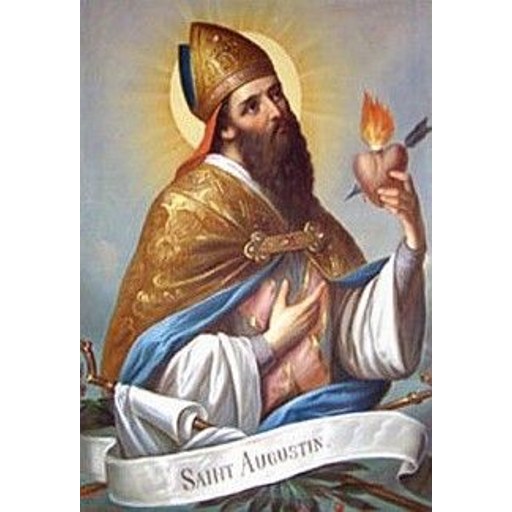
https://www.pinterest.com/ideas/st-augustine-of-hippo-images/955420374777/
License: unknown
Augustine
Saint- Life Span
- 354 - 430 (age 76)
- Feast Day
- 28 August
- Gender
- male
- Church
- Catholic
Places
Roles & Family
Patronage
theologians;philosophers;printers;brewers;sore eyes;Saint Augustine, Florida
Biography
Aurelius Augustinus, known as Augustine of Hippo, was born in 354 at Thagaste in the Roman province of Numidia in North Africa. His father, Patricius, was a municipal official of modest rank who remained a pagan until near the end of his life; his mother, Monica, was a committed Christian whose prayers and counsel later occupied a central place in Augustine's own narrative of conversion. He received a classical education in Latin grammar and rhetoric at Thagaste, Madauros, and Carthage. In adolescence and early adulthood he adhered to Manichaeism, lived for some fifteen years with an unnamed companion to whom he was not legally married, and fathered a son, Adeodatus. He taught rhetoric at Carthage, then at Rome, and finally at Milan, then the principal imperial residence in the West, where professional ambition and intellectual dissatisfaction exposed him to new philosophical and Christian influences.
At Milan, Augustine heard the preaching of Bishop Ambrose and read Neoplatonic works that helped him abandon Manichaean materialism and recast the problems of evil and of God's nature. In 386, in a garden in Milan, he underwent a decisive conversion, described in the Confessions as prompted by a child's voice urging him to take up and read, and by a passage from the Letter to the Romans. He resigned his chair of rhetoric, withdrew with friends to Cassiciacum, and was baptized by Ambrose at Easter in 387, together with Adeodatus and his friend Alypius. Shortly afterward Monica died at Ostia as they prepared to return to Africa. Back in Thagaste he formed a community devoted to prayer and study. In 391, while visiting Hippo Regius, he was pressed into ordination as priest by the local church and Bishop Valerius; he became coadjutor and then bishop of Hippo around 395 or 396 and remained in that see until his death.
As bishop, Augustine combined pastoral care and preaching with a vast literary output and a leading role in the North African church. He opposed the Donatist schism, arguing that the validity of the sacraments does not depend on the personal worthiness of the minister and that the Catholic Church must remain one; the Conference of Carthage in 411 was a turning point against Donatism. He also wrote against remaining Manichaeans and, from about 411, against Pelagius and his followers, defending the necessity of divine grace, the reality of original sin, and infant baptism. His letters and treatises engaged correspondents across the Mediterranean. At Hippo he organized clerical life along monastic lines and composed a rule that later inspired Western religious communities, though he himself belonged to no later named religious order.
His principal works include the Confessions, a spiritual autobiography and meditation on memory, time, and God; De Trinitate, a sustained inquiry into the Trinity; De civitate Dei (The City of God), begun after the sack of Rome in 410, which contrasts the earthly and heavenly cities and offers a Christian reading of history; and a large body of sermons, letters, and biblical commentaries, including writings on Genesis, the Psalms, and the Gospel of John. His teaching on grace, free will, the Church, just war, and the interpretation of Scripture shaped Latin theology for centuries and later influenced both medieval scholasticism and the Protestant Reformation.
Augustine died on 28 August 430 in Hippo Regius while the city was under siege by the Vandals. He was first buried at Hippo; later tradition holds that his relics were translated and eventually enshrined in the basilica of San Pietro in Ciel d'Oro in Pavia. Venerated from an early date, without a later formal process of canonization of the medieval or modern type, he is honored as a Doctor of the Church and as one of the principal Fathers of Western Christianity. His feast is kept on 28 August in the Latin calendar.