Augustine is a saint of the Catholic Church (354 - 430). Augustine's feast day is celebrated on 28 August. Augustine is the patron saint of theologians;printers;brewers;philosophers;those with sore eyes;Saint Augustine, Florida;Bridgeport, Connecticut.
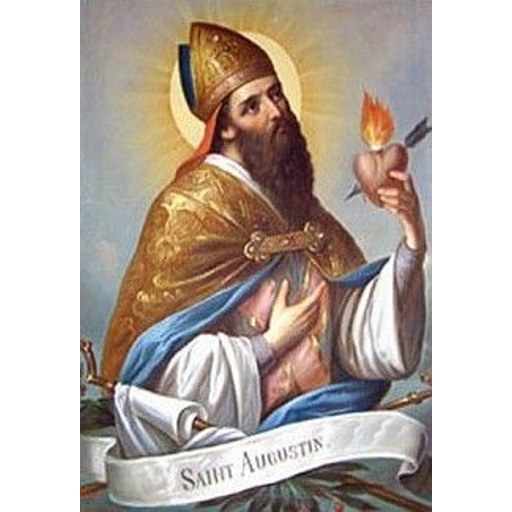
https://www.pinterest.com/ideas/st-augustine-of-hippo-images/955420374777/
License: unknown
Augustine
Saint- Life Span
- 354 - 430 (age 76)
- Feast Day
- 28 August
- Gender
- male
- Church
- Catholic
Places
Roles & Family
Patronage
theologians;printers;brewers;philosophers;those with sore eyes;Saint Augustine, Florida;Bridgeport, Connecticut
Biography
Augustine of Hippo, born Aurelius Augustinus in 354 at Thagaste in Roman Numidia (present-day Souk Ahras, Algeria), was the son of Patricius, a municipal official of modest rank who remained a pagan until near the end of his life, and Monica, a committed Christian later venerated as a saint. He received a classical Latin education at Thagaste, Madauros, and Carthage, distinguishing himself in rhetoric while living a youth he later portrayed as intellectually ambitious and morally restless. For about nine years he adhered to Manichaeism. He taught rhetoric in Carthage and, after a stay in Rome, obtained through the pagan prefect Symmachus a professorship of rhetoric at Milan, then the Western imperial residence. During these years he lived with an unnamed companion of lower social status, a relationship of concubinage rather than legal marriage, and they had a son, Adeodatus.
In Milan, Augustine came under the influence of Bishop Ambrose, whose preaching, together with Neoplatonic writings, undermined his Manichaean materialism and prepared him for Catholic Christianity. After a conversion in a garden in 386 he resigned his chair, withdrew with friends to Cassiciacum, and was baptized by Ambrose at the Easter vigil of 387, together with Adeodatus and his friend Alypius. Monica died at Ostia as they prepared to return to Africa. Back in Thagaste he formed a community devoted to prayer and study. In 391, while visiting Hippo Regius, he was pressed into the priesthood by the local congregation; he was consecrated bishop, first as coadjutor to the aged Valerius, about 395, and thereafter governed the see of Hippo until his death. He lived with his clergy under a common rule, though he belonged to no later named religious order.
As bishop he preached constantly, administered a busy North African diocese, and produced a body of writing that shaped Latin Christianity. He opposed the Donatist schism over the validity of sacraments conferred by clergy who had lapsed in persecution, arguing for the catholicity of the Church and the objective efficacy of the sacraments. Against Pelagius and his followers he developed his theology of original sin, the necessity of grace, and predestination. After the sack of Rome in 410 he composed The City of God, distinguishing the earthly city from the city of God and offering a Christian reading of history. His Confessions, an unprecedented spiritual autobiography, and De Trinitate stand among the central works of Western theology and literature. He also left extensive letters, sermons, and a monastic rule that later inspired the Augustinian tradition.
Augustine died on 28 August 430 while Hippo was under siege by the Vandals. He was already regarded as a teacher of the Church in his own lifetime and was later numbered among the four great Latin Doctors. His remains were in time translated from Hippo to the basilica of San Pietro in Ciel d'Oro in Pavia. He is commemorated on 28 August. His thought on grace, the inner life, just war, and the two cities has remained a foundation of Western Christian intellectual history.