Augustine is a saint of the Catholic Church (354 - 430). Augustine's feast day is celebrated on 28 August. Augustine is the patron saint of brewers;printers;theologians;philosophers;converts;sore eyes;the Augustinian Order;the city of Saint Augustine, Florida.
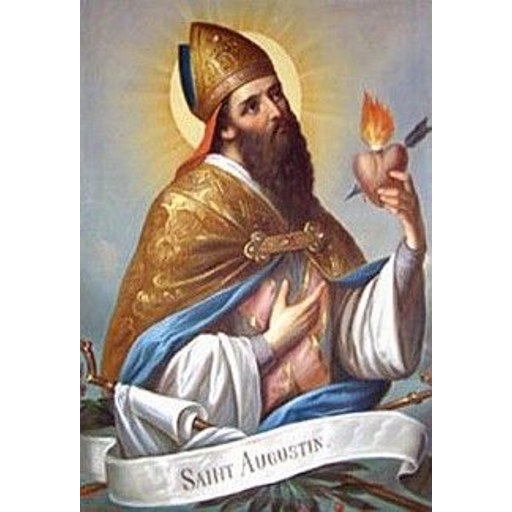
https://www.pinterest.com/ideas/st-augustine-of-hippo-images/955420374777/
License: unknown
Augustine
Saint- Life Span
- 354 - 430 (age 76)
- Feast Day
- 28 August
- Gender
- male
- Church
- Catholic
Places
Roles & Family
Patronage
brewers;printers;theologians;philosophers;converts;sore eyes;the Augustinian Order;the city of Saint Augustine, Florida
Biography
Aurelius Augustinus, known as Augustine of Hippo, was born in 354 at Thagaste in the Roman province of Numidia (in present-day Algeria) to Patricius, a modest municipal official who was a pagan for most of his life, and Monica, a committed Christian whose later cult made her one of the best-known maternal figures in Latin Christianity. He received a classical education in Thagaste, Madauros, and Carthage, training above all in rhetoric. In adolescence and early adulthood he lived with an unnamed companion for many years and had a son, Adeodatus; he was never legally married. For about a decade he adhered to Manichaeism, then moved through Academic skepticism. He taught rhetoric in Carthage, briefly in Rome, and then in Milan, then the imperial residence in the West.
In Milan he heard the preaching of Bishop Ambrose and read Neoplatonic works in Latin translation, which helped him abandon a crudely material conception of God. After a well-known conversion in a garden in 386, he was baptized by Ambrose at Easter 387 together with Adeodatus and his friend Alypius. Monica died at Ostia as the party prepared to return to Africa. Back in Numidia, Augustine sold his property and established a lay monastic community at Thagaste devoted to prayer, study, and common life. In 391, while visiting Hippo Regius, he was pressed into ordination as priest by Bishop Valerius; he later succeeded Valerius as bishop of Hippo, probably in 395 or 396. He continued a communal clerical life in the episcopal household and composed a rule that later inspired Western Augustinian canons and friars, though he himself belonged to no later named religious order.
As bishop he preached constantly, administered a busy North African see, and wrote against Manichaeans, Donatists, and Pelagians. His major works include the Confessions, the City of God (composed in the aftermath of the sack of Rome in 410), De Trinitate, numerous biblical commentaries and sermons, and treatises on grace, free will, and original sin that shaped Latin theology for centuries. He developed influential accounts of just war, the nature of the Church and the sacraments, and the relation of the earthly and heavenly cities. He died on 28 August 430 in Hippo while the city was under siege by the Vandals. Veneration began without a later-style papal canonization; he was later numbered among the Doctors of the Church. Relics associated with him were translated in the early Middle Ages and are traditionally housed at San Pietro in Ciel d'Oro in Pavia.