Augustine is a saint of the Catholic Church (354 - 430). Augustine's feast day is celebrated on 28 August. Augustine is the patron saint of theologians;philosophers;printers;brewers;sore eyes;Bridgeport, Connecticut;Cagayan de Oro.
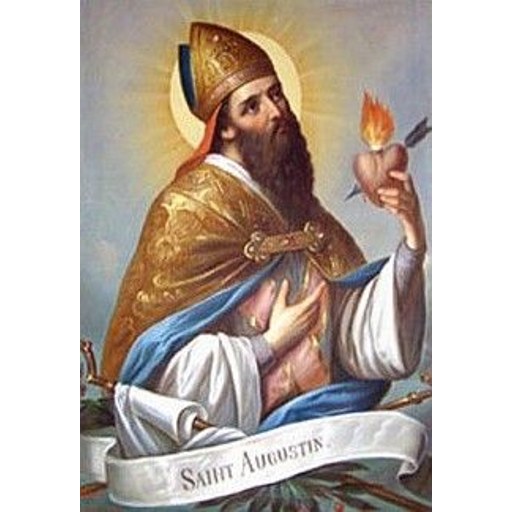
https://www.pinterest.com/ideas/st-augustine-of-hippo-images/955420374777/
License: unknown
Augustine
Saint- Life Span
- 354 - 430 (age 76)
- Feast Day
- 28 August
- Gender
- male
- Church
- Catholic
Places
Roles & Family
Patronage
theologians;philosophers;printers;brewers;sore eyes;Bridgeport, Connecticut;Cagayan de Oro
Biography
Aurelius Augustinus, known as Augustine of Hippo, was born in 354 at Thagaste in the Roman province of Numidia in North Africa. His father, Patricius, was a curial official of modest means and remained a pagan until baptism near the end of his life; his mother, Monica, was a committed Christian whose prayers and counsel occupy a central place in Augustine's later account of his conversion. He received a classical education in Thagaste, Madauros, and Carthage, distinguishing himself in rhetoric while living a youth he afterward described as restless and morally disordered. For about nine years he adhered to Manichaeism, drawn by its claim to explain the origin of evil and by its standing among cultured circles. He formed a long relationship with a concubine, by whom he had a son, Adeodatus, and he taught rhetoric in Carthage, then briefly in Rome, and from 384 in Milan, then the principal imperial residence in the West.
In Milan, Augustine came under the influence of Bishop Ambrose, whose preaching and figurative reading of Scripture helped him abandon Manichaeism and reconsider Catholic Christianity. He also read Neoplatonic works, which he later said enabled him to think of God as spiritual rather than corporeal. After a prolonged intellectual and moral crisis, recalled in the garden episode of the Confessions, he determined to seek baptism. At the Easter Vigil of 387 he was baptized by Ambrose, together with Adeodatus and his friend Alypius. Shortly afterward, while the party prepared to return to Africa, Monica died at Ostia. Augustine settled again at Thagaste and lived there in a community of prayer, study, and common life with friends, a pattern that shaped his later clerical household.
In 391, while visiting Hippo Regius, he was ordained priest at the urging of the local church and of Bishop Valerius. He quickly became known as a preacher and controversialist, and around 395 or 396 he was consecrated bishop, succeeding Valerius. As bishop he organized the clergy of Hippo along monastic lines, preached constantly, and administered a busy African see. He spent years in controversy with the Donatists, whose schism divided North African Christianity over the purity of the church and the validity of sacraments conferred by clergy who had lapsed in persecution. He also wrote against remaining Manichaeans and, from the 410s, against Pelagius and Caelestius on grace, original sin, and infant baptism. His letters and sermons show a bishop entangled in the legal, social, and religious conflicts of late Roman Africa, including the use of imperial authority against Donatist violence, a policy he came to defend.
Augustine's principal writings include the Confessions, a spiritual autobiography and meditation on memory, time, and God; De Trinitate, a long inquiry into the Trinity; and De civitate Dei, begun after the Gothic sack of Rome in 410, which interprets sacred and secular history through the earthly and heavenly cities. He left treatises on Scripture, free will, the soul, and Christian doctrine, together with a large correspondence and numerous sermons. He died on 28 August 430 in Hippo while the city was under siege by the Vandals. Later tradition holds that his relics were taken from Africa to Sardinia and, in the eighth century, to the church of San Pietro in Ciel d'Oro in Pavia. Already venerated in late antiquity, he was counted among the Latin Doctors of the Church; his teaching on grace, the church, and the two cities has shaped Western theology for centuries.