Augustine is a saint of the Catholic Church (354 - 430). Augustine's feast day is celebrated on 28 August. Augustine is the patron saint of theologians;printers;brewers;philosophers;sore eyes;Saint Augustine, Florida;Bridgeport, Connecticut;Cagayan de Oro;Tübingen;Augustinians.
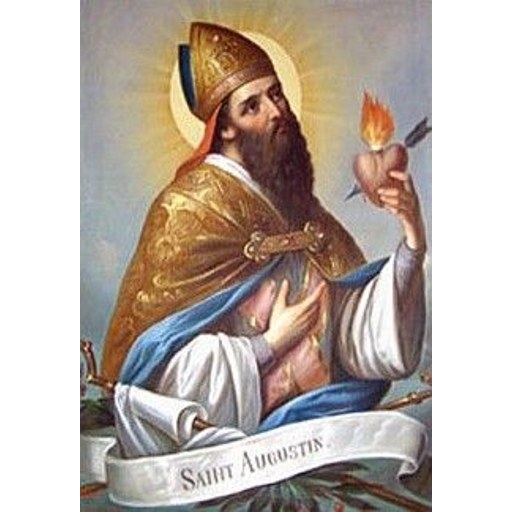
https://www.pinterest.com/ideas/st-augustine-of-hippo-images/955420374777/
License: unknown
Augustine
Saint- Life Span
- 354 - 430 (age 76)
- Feast Day
- 28 August
- Gender
- male
- Church
- Catholic
Places
Roles & Family
Patronage
theologians;printers;brewers;philosophers;sore eyes;Saint Augustine, Florida;Bridgeport, Connecticut;Cagayan de Oro;Tübingen;Augustinians
Biography
Aurelius Augustinus, known as Augustine of Hippo, was born in 354 in Thagaste, a municipium in the Roman province of Numidia in North Africa, to Patricius, a local decurion of modest means who remained a pagan until late in life, and Monica, a fervent Christian whose prayers and persistence later became central to Augustine's own account of his conversion. He received a classical education in Thagaste, Madauros, and Carthage, excelling in rhetoric while, by his own later admission, living a restless and morally disordered youth. In Carthage he took a concubine, with whom he lived for about fifteen years and had a son, Adeodatus. For nearly a decade he adhered to Manichaeism, attracted by its claim to explain evil and by its appeal to a young man trained in disputation. He taught rhetoric in Carthage, then in Rome, and finally in Milan, then the imperial residence, where he held a prestigious public chair.
In Milan, Augustine came under the influence of Bishop Ambrose, whose preaching and the Neoplatonic intellectual circle around him helped dismantle Augustine's Manichaean materialism and his remaining academic skepticism. After a prolonged interior struggle, described in the eighth book of the Confessions, he converted to Catholic Christianity in 386 and was baptized by Ambrose at the Easter Vigil in 387, together with Adeodatus and his friend Alypius. Shortly afterward, while waiting to sail back to Africa, his mother Monica died at Ostia. Augustine returned to Thagaste, where he established a small community of laymen devoted to prayer and study. Adeodatus died not long after. In 391, while visiting Hippo Regius, Augustine was pressed into ordination as a priest by the local church and Bishop Valerius; he was consecrated coadjutor bishop about 395 and succeeded to the see of Hippo, which he held until his death.
As bishop, Augustine preached constantly, administered a busy African diocese, and engaged in the major theological controversies of his age. He wrote extensively against the Manichaeans, arguing for the goodness of creation and for evil as a privation of good. Against the Donatists, who had divided the North African church over clerical purity and the validity of sacraments conferred by traditores, he developed a theology of the church as a mixed body and of sacramental efficacy independent of the minister's personal holiness, and he eventually accepted the use of imperial coercion against the schism. Against Pelagius and his followers he articulated a doctrine of original sin, the necessity of grace, and the gratuity of predestination that would shape Western theology for centuries. His major works include the Confessions, an unparalleled spiritual autobiography; De Trinitate, a sustained exploration of the triune God; and De civitate Dei (The City of God), begun after the Gothic sack of Rome in 410, which offered a Christian interpretation of history and a critique of pagan Rome.
Augustine died on 28 August 430 in Hippo Regius while the city was under siege by the Vandals of Genseric. He left a vast corpus of sermons, letters, and treatises that made him the most influential Latin Father of the Church and, later, a Doctor of the Church. His Rule, drawn from his experience of common life with his clergy, became the foundation of numerous medieval religious communities, including the later Order of Saint Augustine. Relics associated with him were eventually translated from Africa to Sardinia and, in the eighth century, to the basilica of San Pietro in Ciel d'Oro in Pavia, where they are still venerated. His feast is kept on 28 August in the Latin Church.