Augustine is a saint of the Catholic Church (354 - 430). Augustine's feast day is celebrated on 28 August. Augustine is the patron saint of theologians;printers;brewers;philosophers;sore eyes.
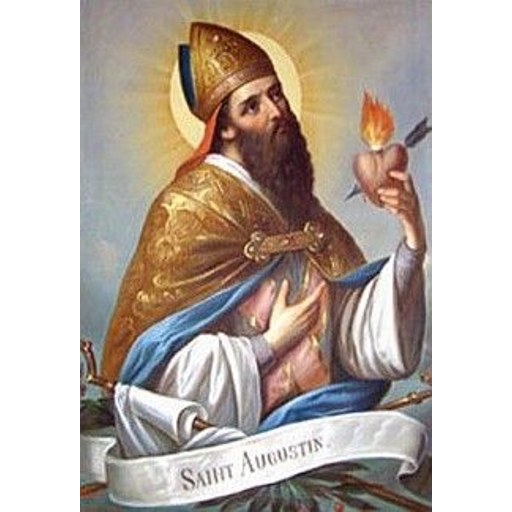
https://www.pinterest.com/ideas/st-augustine-of-hippo-images/955420374777/
License: unknown
Augustine
Saint- Life Span
- 354 - 430 (age 76)
- Feast Day
- 28 August
- Gender
- male
- Church
- Catholic
Places
Roles & Family
Patronage
theologians;printers;brewers;philosophers;sore eyes
Biography
Aurelius Augustinus, known as Augustine of Hippo, was born in 354 at Thagaste in the Roman province of Numidia, in North Africa. His father Patricius was a local curiale of modest standing and a pagan who received baptism only near the end of his life; his mother Monica was a devout Christian whose long intercession for her son later became a central theme of Augustine’s spiritual autobiography. He received a classical Latin education at Thagaste, Madauros, and Carthage and excelled in rhetoric. In youth he adhered for about nine years to Manichaeism, lived with an unnamed companion by whom he had a son, Adeodatus, and taught rhetoric in Carthage, then briefly in Rome, and from 384 in Milan, then the principal imperial residence in the West.
In Milan he heard Bishop Ambrose preach and encountered Neoplatonic writings that helped him abandon Manichaean materialism and overcome intellectual objections to Catholic Christianity. After an interior crisis described in the Confessions, including the garden scene at Milan in 386, he resigned his chair of rhetoric, withdrew with companions to Cassiciacum, and was baptized by Ambrose at the Easter vigil of 387, together with Adeodatus and his friend Alypius. Monica died at Ostia as the party prepared to return to Africa. Back in Thagaste, Augustine formed a lay community devoted to prayer and study. While visiting Hippo Regius in 391 he was ordained priest by Bishop Valerius; he was associated in the episcopate and became bishop of Hippo about 395 or 396, remaining in that office until his death.
As bishop he preached continually, governed a busy African see, and wrote against Manichaeans, Donatists, and Pelagians, as well as producing exegetical, doctrinal, and pastoral works. The Confessions (written around the turn of the fifth century) offered an unprecedented account of memory, sin, and conversion. De Trinitate examined the Trinity through analogies drawn from the human mind. De civitate Dei, begun after the sack of Rome in 410, answered pagan charges against Christianity and set out a theology of history contrasting the earthly city with the City of God. His writings on original sin, grace, and predestination deeply marked later Latin theology. He also left a monastic rule that later inspired many religious communities, though he himself belonged to no later medieval order.
Augustine died on 28 August 430 while Hippo was under Vandal siege. He was venerated as a saint already in late antiquity and was subsequently numbered among the Doctors of the Church. According to tradition his relics were taken from Hippo to Sardinia and, in the eighth century, to Pavia, where they are honored in the basilica of San Pietro in Ciel d'Oro. His principal feast in the Latin Church is 28 August. He is invoked as patron of theologians, printers, brewers, and philosophers, and against sore eyes. His thought remains a foundation of Western Christian theology, philosophy, and spirituality.