Augustine of Canterbury is a saint of the Catholic Church (d. 604). Augustine of Canterbury's feast day is celebrated on 26 May. Augustine of Canterbury is the patron saint of England.
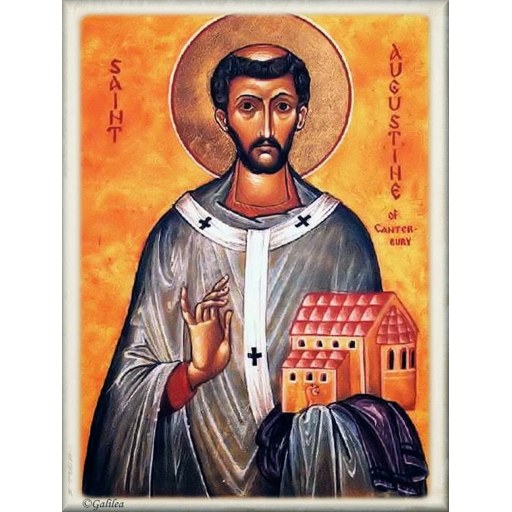
NN
License: Public domain
Augustine of Canterbury
Saint- Life Span
- d. 604
- Feast Day
- 26 May
- Gender
- male
- Church
- Catholic
Places
Relics & Where to Venerate
Location unknown
The bodily remains of Augustine of Canterbury are a first-class relic. Venerated at St Augustine's Abbey.
Roles & Family
Religious Information
Patronage
England
Canonization
Biography
Augustine of Canterbury was a monk of the late sixth century who became the first archbishop of Canterbury and the leader of the Gregorian mission that established Roman Christianity among the Anglo-Saxons of Kent. Almost nothing is recorded of his birth, family, or early years. The principal source for his life is the Ecclesiastical History of the English People written by the Northumbrian monk Bede in the early eighth century, supplemented by letters of Pope Gregory the Great that survive in Gregory’s register. Augustine appears in these sources as prior of the monastery of Saint Andrew on the Coelian Hill in Rome, a community founded by Gregory on land that had belonged to his family. In 595 or 596 Gregory, who as a deacon had once encountered Anglian slave boys in the Roman market and thereafter desired the conversion of their people, chose Augustine to head a party of monks sent to preach in Britain.
The missionaries crossed Gaul and, according to Bede, grew fearful of the unknown land and its inhabitants; Augustine returned to Rome to ask that the mission be abandoned. Gregory refused and sent him north again with letters of commendation to Frankish rulers and bishops and with instructions that Augustine should be obeyed as abbot. In 597 the party landed in Kent, on the Isle of Thanet or at a nearby harbor. King Æthelberht, whose wife Bertha was a Christian princess from the Frankish royal house and who already maintained a chapel at Saint Martin’s in Canterbury served by her chaplain Liudhard, received the newcomers cautiously. He heard their preaching, granted them a residence in Canterbury and liberty to evangelize, and in time accepted baptism himself. Large numbers of Kentish people were baptized thereafter. Augustine restored Saint Martin’s for worship and began the construction of a monastery dedicated to Saints Peter and Paul to the east of the city, which later bore his own name. He also recovered and reconsecrated an old Roman church that became Christ Church, the cathedral of the new see.
Pope Gregory continued to direct the mission by letter. In 601 he sent a second group of missionaries, among them Mellitus, Justus, Paulinus, and Rufinianus, together with sacred vessels, vestments, relics, manuscripts, and the pallium that made Augustine metropolitan archbishop with authority to consecrate other bishops. Gregory’s replies to a questionnaire from Augustine, preserved by Bede, treat questions of ritual, the degrees of kinship within which marriage might be allowed, the consecration of bishops, and the fate of pagan temples; the pope advised that idols be destroyed but that well-built temples be sprinkled with holy water and converted to Christian use, so that the people might more readily abandon error. Augustine consecrated Mellitus to the see of London for the East Saxons and Justus to Rochester. A plan to erect a second metropolitan see at York was not realized in Augustine’s lifetime. He also attempted to secure the obedience of the British clergy who had survived in the west of the island since the Roman period. Conferences with those bishops, one of them held at a place Bede calls Augustine’s Oak, failed. Bede relates that the British party took offense when Augustine did not rise to greet them and that they rejected both his claim to jurisdiction and the Roman dating of Easter.
Augustine died on 26 May 604 and was buried in the still unfinished monastic church of Saints Peter and Paul at Canterbury; after the building was completed his body was translated into the north porch and later into the church itself. He was succeeded by Laurentius, who had been one of his companions from Rome. Although the mission remained confined largely to Kent and a few neighboring territories at his death, and although the British churches remained separate, later generations regarded Augustine as the founder of the English Church. His cult developed at his tomb in the abbey that came to be called Saint Augustine’s. He is venerated as a saint in the Catholic Church, the Anglican Communion, and the Eastern Orthodox Church. Later medieval writers elaborated miracle stories already present in Bede, including the healing of a blind man offered as a sign to the British bishops, but the documentary core of his life remains the correspondence of Gregory and the narrative of Bede.