Aunarius is a saint of the Catholic Church (d. 603). Aunarius's feast day is celebrated on 25 September.
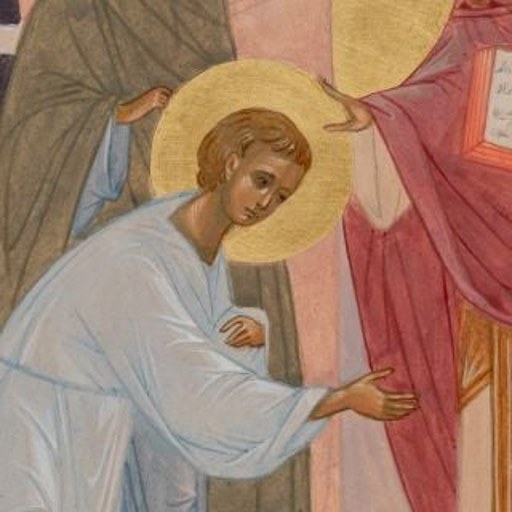
https://catalog.obitel-minsk.com/icons-prav/painted-icons.html
License: unknown
Aunarius
Saint- Life Span
- d. 603
- Feast Day
- 25 September
- Gender
- male
- Church
- Catholic
Places
Roles & Family
Biography
Saint Aunarius (also known as Aunacharius, Aunaire, or Anacharius) was a Merovingian-era bishop of Auxerre in Frankish Gaul. Surviving accounts describe him as born into a senatorial family associated with Orléans; his father is named Pastor and his mother Veneranda, who was later locally venerated. No reliable source records a precise year of birth, and it should not be inferred from the date of his episcopal election. He was formed for church life under Saint Syagrius, bishop of Autun, and was ordained to the priesthood before being chosen bishop of Auxerre around 572, in succession to that see.
As bishop he took part in the principal Frankish councils of his generation, including the Council of Paris in 573 and councils held at Mâcon in the 580s. He sought to have conciliar canons observed in his diocese and is associated with circulating disciplinary instructions to that end. In the liturgical sphere he instituted solemn three-day litanies, or rogations, in Auxerre on the model of those linked with Saint Mamertus of Vienne, to be observed on the days before the Ascension. He also encouraged the writing down of the lives of earlier bishops of Auxerre, an impulse that stands behind the later historical tradition of that church, including the Gesta pontificum Autissiodorensium.
Aunarius occupied the see for more than three decades. Near-contemporary material presents him as a pastor concerned with clerical discipline, liturgical order, and the memory of local saints. He died on 25 September, in 603 according to the usual reckoning of the martyrologies and of standard modern notices. A Latin vita composed not long after his death became an important source for the late Merovingian church of Auxerre. His feast is kept on 25 September, and he is entered in the Roman Martyrology as bishop and confessor at Auxerre. Later medieval translations of relics and legendary expansions are reported in diocesan tradition, but many of those elaborations cannot be verified from early evidence. His cult remained that of a local confessor-bishop rather than of a figure with a widely attested list of patronages.