Autonomus is a saint of the Pre-Schism (Universal) Church (d. 313). Autonomus's feast day is celebrated on 12 September.
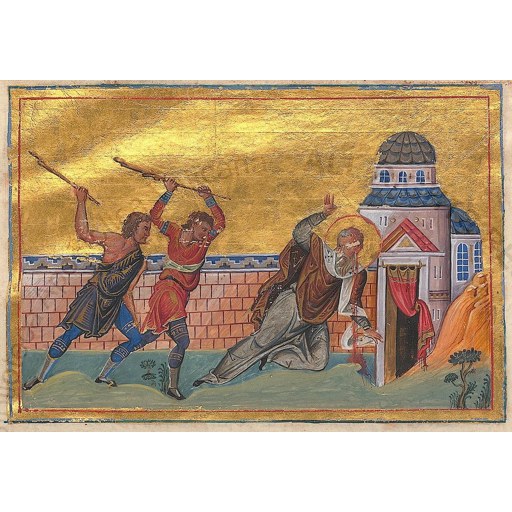
Authors of Menologion of Basil II (circa 985 AC, Constantinople), Byzantine manuscript illuminators[1]: Pantoleon with Georgios, Michael the Younger, Michael of Blachernae, Symeon, Symeon of Blachernae, Menas, and Nestor (Online on Vatican site)
License: Public domain
Autonomus
Saint- Life Span
- d. 313
- Feast Day
- 12 September
- Gender
- male
- Church
- Pre-Schism (Universal)
Places
Roles & Family
Biography
Saint Autonomus, known in Greek as Autonomos, was a Christian bishop of Italian origin who is venerated as a hieromartyr in the Eastern Orthodox Church and is also entered in the Roman Martyrology. Almost everything that can be said about him comes from later liturgical and hagiographical tradition, especially the Byzantine synaxaria, rather than from contemporary fourth-century documents. Those sources present him as already a bishop in Italy when the Great Persecution begun under the emperor Diocletian in the early fourth century made open pastoral work dangerous. He therefore left Italy and went east to Bithynia in northwestern Asia Minor, then a province of the Roman Empire.
According to the traditional Life, Autonomus settled at a place called Soreoi (also rendered Soreus), associated with the region of the Sangarius River. There he preached, converted many of the local inhabitants from paganism, and built a church dedicated to the Archangel Michael. He ordained a disciple named Cornelius to the diaconate; Cornelius later became a bishop and is himself commemorated in some calendars. Autonomus is also described as traveling to evangelize in Lycaonia and in districts toward Paphlagonia before returning to the community at Soreoi. The growth of the Christian congregation and the associated decline of local cults are said to have provoked hostility among those who remained attached to the traditional religions.
The accounts of his death state that pagans attacked him while he was celebrating the Eucharist and that he was killed at the altar, which is why he is classed as a hieromartyr. Later tradition commonly places the martyrdom about the year 313, near the end of imperial persecution in the East. After his death the work of the community was continued by Cornelius and others. In subsequent centuries his relics were reported to have been discovered and honored, and a church at or near the site of his martyrdom was associated with his cult. The precise location of Soreoi has not been identified with certainty by modern scholarship, and no episcopal see in Italy can be securely attached to his name.
Saint Autonomus is commemorated on 12 September in the Eastern Orthodox liturgical calendar. The Roman Martyrology recalls on the same date an Italian bishop who converted many in Bithynia and was slain at the altar by unbelievers. He belongs to the large number of early martyrs whose public cult arose from local and liturgical memory rather than from a formal process of canonization by a later pope. No reliable source records a spouse, children, or membership in a later religious order, and he is not widely invoked as the patron of particular cities, trades, or causes. The historical figure remains obscure; the value of his dossier lies chiefly in the picture it gives of an Italian cleric continuing missionary work in Asia Minor at the close of the age of persecutions.