Balthild is a saint of the Catholic Church (d. 680). Balthild's feast day is celebrated on 30 January. Balthild is the patron saint of children;widows;the sick.
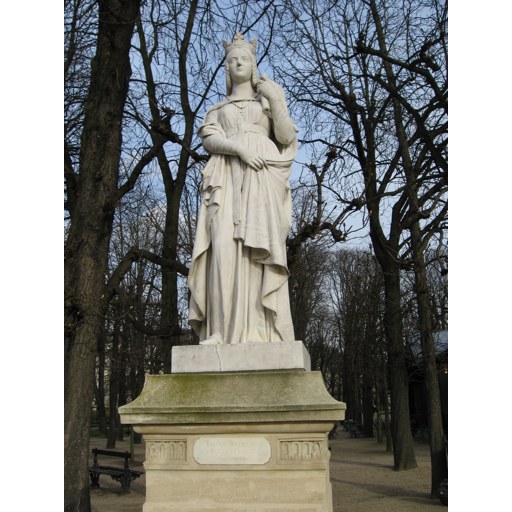
Tosca
License: CC BY-SA 3.0
Balthild
Saint- Life Span
- d. 680
- Feast Day
- 30 January
- Gender
- female
- Church
- Catholic
Places
Relics & Where to Venerate
Location unknown
The bodily remains of Balthild are a first-class relic. Venerated at Royal Abbey of Chelles.
Roles & Family
Religious Information
Patronage
children;widows;the sick
Biography
Balthild, also spelled Bathild, Bathilda, or Balthilda, was a seventh-century Anglo-Saxon woman who rose from slavery to become queen of the Frankish kingdoms of Neustria and Burgundy and who later entered monastic life at Chelles, where she was venerated as a saint after her death. The principal source for her life is the Vita Sanctae Balthildis, a Latin hagiography composed shortly after she died, probably at Chelles itself in the late seventh century. According to that text she belonged to the Saxon people from across the sea. Later medieval writers sometimes identified her as a member of an English royal house, in particular the dynasty of East Anglia, but this claim is not found in the earliest Life and cannot be verified. As a child or adolescent she was sold into slavery and brought to Gaul. She served in the household of Erchinoald, the powerful mayor of the palace of Neustria. The Vita describes her as modest, industrious, and devout, and relates that after the death of Erchinoald’s wife he wished to marry her; she is said to have hidden herself and so escaped that marriage.
She instead became the consort of Clovis II, king of Neustria and Burgundy, a marriage that most historians place in the later 640s. As queen she gained a reputation for personal piety and for charity, including the ransoming of captives and slaves. She and Clovis II had three sons: Chlothar III, Childeric II, and Theuderic III, each of whom later reigned as a Frankish king. When Clovis II died, around 657, Chlothar III was still a child, and Balthild exercised the regency in Neustria and Burgundy. In that capacity she worked with, and at times against, the mayors of the palace, first Erchinoald and then Ebroin. Contemporary and near-contemporary sources credit her with attempting to forbid the trade in Christian slaves, with resisting simony in the appointment of bishops, and with generous patronage of monasteries. She is associated with the foundation or refoundation of Chelles near Paris and of Corbie in Picardy, and with gifts to Saint-Denis, Jumièges, Luxeuil, and other houses. Her years of power were politically turbulent. Some sources, notably the Passion of Saint Aunemund of Lyon, implicate the queen or her agents in the murder of Bishop Aunemund; the Vita, by contrast, depicts her as a defender of the Church and a promoter of peace among the Franks.
In the mid-660s Balthild withdrew from the court and took the veil at Chelles. The Vita presents this as a freely chosen retirement to a house she herself had endowed; other evidence suggests that she may have been forced from power by a coalition of Neustrian magnates and by Ebroin. At Chelles she lived under the authority of Abbess Bertilla and is described as practicing humility, obedience, and care for the sick and the poor. She remained there until her death, which tradition and most modern reconstructions date to 30 January 680. She was buried in the abbey church at Chelles.
Her tomb became a focus of veneration almost immediately. The Vita Sanctae Balthildis portrayed her as a model of the Christian queen who combined royal authority with charity and who ended her life as a humble nun. The Frankish Church commemorated her as a saint, and her feast was established on 30 January. Chelles remained the principal center of her cult through the Middle Ages, and her relics were preserved there for centuries. In later Catholic tradition she has been invoked as a patron of children, of widows, and of the sick, reflecting both her own experience as a former slave and mother and the charitable works attributed to her in the sources.