Barlaam of Khutyn is a venerable of the Catholic Church (d. 1192). Barlaam of Khutyn's feast day is celebrated on 6 November. Barlaam of Khutyn is the patron saint of Novgorod.
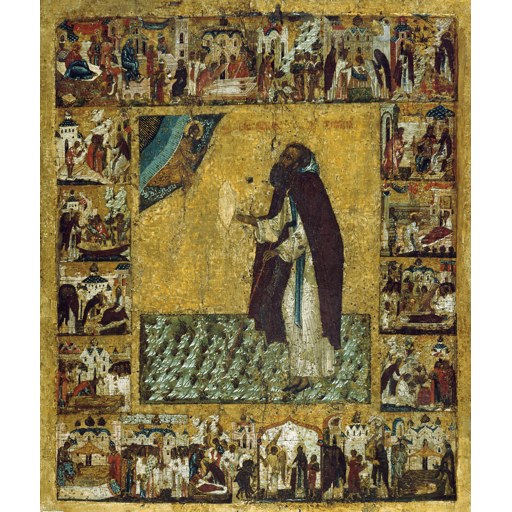
AnonymousUnknown author
License: Public domain
Barlaam of Khutyn
Venerable- Life Span
- d. 1192
- Feast Day
- 6 November
- Gender
- male
- Church
- Catholic
Places
Roles & Family
Patronage
Novgorod
Canonization
Biography
Barlaam of Khutyn, known in Church Slavonic tradition as Varlaam Khutynsky and in the world as Alexa, was a monk and monastic founder of the Novgorod land in the twelfth century. He is numbered among the saints of the Eastern Orthodox Church. Early sources do not record the year of his birth. They present him as a native of Novgorod, born to a family of substantial means. After the death of his parents he disposed of his inheritance in favor of the poor and left secular life. He received the monastic tonsure and the name Barlaam. The surviving Life, whose core is generally placed in the thirteenth century and which was later expanded, is the main narrative source; the Novgorod chronicles supply a few contemporary notices that help to anchor the foundation of his monastery in the early 1190s.
Seeking solitude, Barlaam established himself at Khutyn, on the right bank of the Volkhov River about ten kilometers north of Novgorod. The site was then regarded as a wild and inhospitable place, associated in local memory with an evil reputation. There he lived as a hermit until companions joined him and a coenobitic community took shape. In 1192, according to the Novgorod First Chronicle, a church of the Holy Saviour (the Transfiguration) was founded at Khutyn by the monk Barlaam. Tradition identifies Archbishop Gregory of Novgorod as the hierarch who consecrated the church. From this beginning arose the Khutyn Monastery of the Transfiguration, which in subsequent generations became one of the wealthiest and most influential monasteries of the Novgorod Republic, receiving land, privileges, and the patronage of posadniks, archbishops, and later Muscovite rulers.
The hagiographical portrait of Barlaam emphasizes ascetic severity, care for the poor, and gifts of insight and miracle. Stories attached to his name include prophetic knowledge of the weather and of coming events, the serving of fish associated with an unexpected frost, and other signs that led contemporaries to regard him as a wonderworker. These tales, whatever the proportion of later embellishment, explain the speed with which his tomb became a focus of prayer. Foreseeing his death, he is reported to have entrusted the monastery to a disciple. He died on 6 November 1192 and was buried in the church he had founded. Local veneration followed; a written Life circulated; and in the fifteenth century, under archbishops such as Euthymius II of Novgorod, the cult was strongly promoted. His relics were uncovered and venerated as incorrupt. By the sixteenth century his feast was observed throughout the Russian Church, in keeping with the wider confirmation of many local Russian saints in the Muscovite period.
Barlaam did not become a bishop, patriarch, or pope; his sanctity is that of a monastic founder and wonderworker. He lived as a celibate monk, and the sources give him neither wife nor children. His chief liturgical commemoration falls on 6 November (corresponding to 19 November on the Gregorian calendar when the Julian calendar is used liturgically). In some Orthodox calendars he is also remembered on the first Friday of the Apostles' Fast. He is honored especially in Novgorod as one of the city's principal heavenly patrons. The Khutyn Monastery remained a pilgrimage center for centuries, was closed and damaged in the Soviet era, and has been restored in more recent times as a monument of Novgorod's medieval Christian culture. Western-style beatification by a pope does not apply to his case; his glorification belongs to Orthodox local and then general recognition rather than to a single dated act of a Roman pontiff.