Basil of Caesarea is a saint of the Catholic Church (330 - 379). Basil of Caesarea's feast day is celebrated on 2 January (Roman Catholic); 1 January (Eastern Orthodox); 30 January (Three Holy Hierarchs). Basil of Caesarea is the patron saint of Cappadocia;hospital administrators;reformers;Russia;monks;education.
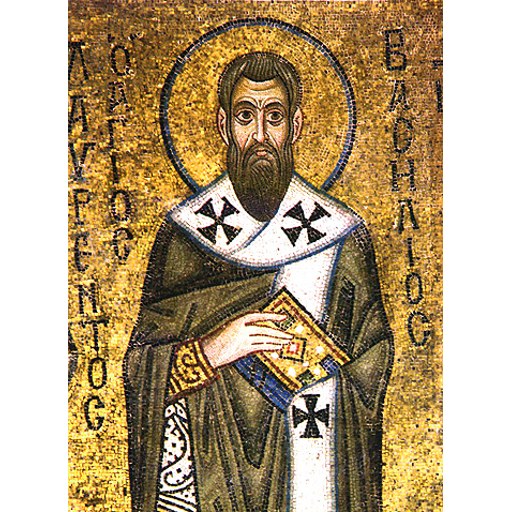
Unknown authorUnknown author
License: Public domain
Basil of Caesarea
Saint- Life Span
- 330 - 379 (age 49)
- Feast Day
- 2 January (Roman Catholic); 1 January (Eastern Orthodox); 30 January (Three Holy Hierarchs)
- Gender
- male
- Church
- Catholic
Places


Roles & Family
Patronage
Cappadocia;hospital administrators;reformers;Russia;monks;education
Canonization
Biography
Basil of Caesarea, known as Basil the Great, was born in the early fourth century, about the year 330, at Caesarea Mazaca in Cappadocia, then a prominent city of the eastern Roman Empire. He belonged to a wealthy and distinguished Christian family that produced several saints, including his grandmother Macrina the Elder, his mother Emmelia, his sister Macrina the Younger, and his brothers Gregory of Nyssa and Peter of Sebaste. His father, Basil the Elder, was a noted rhetorician and advocate. Basil received a thorough education in rhetoric and philosophy, first in Caesarea, then in Constantinople, and finally in Athens, where he formed a close and lasting friendship with Gregory of Nazianzus and studied in the same circles as the future emperor Julian. After returning to Cappadocia he briefly taught rhetoric, following the path expected of a man of his class and training.
A decisive change of life followed. Under the influence of his sister Macrina and after a period of travel among the monastic communities of Egypt, Palestine, Syria, and Mesopotamia, Basil received baptism, gave away much of his property, and withdrew to a family estate at Annesi on the Iris River in Pontus. There he organized a monastic community and, together with Gregory of Nazianzus, compiled the Philocalia of Origen. His Longer and Shorter Rules, known collectively as the Asceticon, became the foundational legislation of Eastern Christian monasticism and later influenced Western rules, including that of Benedict of Nursia. Basil insisted on a coenobitic rather than purely eremitical life, combining prayer, manual work, and service, and he treated the monastery as a school of charity as well as of ascetic discipline.
Ordained to the presbyterate in the 360s by Eusebius of Caesarea, Basil soon emerged as a leading defender of the Nicene faith against Arian and Homoian teaching. In 370 he was elected bishop of Caesarea and metropolitan of Cappadocia. As bishop he created a large charitable complex later called the Basiliad, which included a hospital, a hospice for travelers, and facilities for the poor and sick, an undertaking often regarded as one of the first major Christian social-welfare institutions. He preached extensively on the Hexaemeron, the Psalms, and social ethics, rebuking the wealthy for indifference to famine and usury. His treatise On the Holy Spirit argued for the full divinity of the Holy Spirit and helped prepare the theological settlement associated with the Council of Constantinople of 381. His extensive correspondence remains a principal source for the ecclesiastical and political history of the eastern empire in the 370s.
Basil’s episcopate was marked by conflict with the Arianizing emperor Valens, who divided the province of Cappadocia in an effort to weaken the metropolitan see; Basil responded in part by securing the appointment of his brother Gregory to Nyssa and of Gregory of Nazianzus to Sasima. He worked to reconcile groups that were close to Nicene doctrine but hesitant about the language of Nicaea, and he sought communion with the church of Rome under Pope Damasus I, though the schism at Antioch and Western caution limited the results. Worn by ascetic practice and chronic illness, he died at Caesarea on 1 January 379, shortly before the restoration of Nicene bishops under Theodosius I. Venerated immediately as a saint in East and West, he is counted among the Three Holy Hierarchs with Gregory of Nazianzus and John Chrysostom, and he was later numbered among the Doctors of the Church. His liturgical anaphora, the Liturgy of Saint Basil, remains in use in the Byzantine rite, especially during Lent and on his feast.